Yankee Doodle Brandy

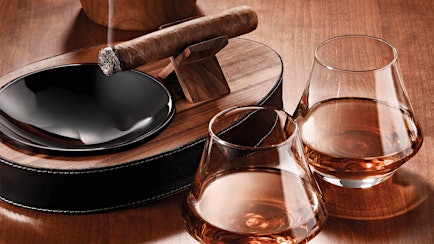
When you think of fine brandy it’s more than likely that the first thing that comes to mind is Cognac, the king of the category. It’s a product made only in the Cognac region of France, a distilled wine that blossoms with age and has proven to be a perfect partner for fine cigars.
But brandy can be made anywhere you have grapes (for that matter any fruit). In the United States—a country known for freedom and a capitalist spirit—the brandy makers there defy popular perceptions by taking advantage of the latitude to do things that simply can’t be done in Cognac or Armagnac, its lesser-known cousin. In recent years, U.S. brandy makers have emerged with a small coterie of virtuoso examples worthy of praise even as they bend the traditions of brandy making.
Exemplars of the American output also make excellent pairings with fine cigars. Jeff O’Neill, the founder and CEO of O’Neill Vintners & Distillers, maker of BrandyLab, is a fan of both in tandem. He credits the fruit-forward nature of the spirits with enhancing the partnership. His favorite cigars with BrandyLab? Cuban cigars with spicy wrappers, such as the iconic Montecristo No. 2 and the Bolivar Belicoso Fino.

Elevated brandy distillation is spread across the nation with such entrants as California’s Argonaut, Germain-Robin, Osocalis and St. George, Louisville’s Copper & Kings, Oregon’s Clear Creek, Virginia’s Catoctin Creek and New Jersey’s Laird.
Master distiller and master blender Hubert Germain-Robin became a leader in American brandy making, having emigrated from Cognac to the United States determined to “make the best liquid possible.” The Cognac native went on to create the brandy named for him with a California rancher named Ansley Coale in 1982. Germain-Robin is today part of Gallo, the California-based, wine-making giant. The spirit was an early example of what would become a renaissance in American brandy.
When asked why he came to this country, Germain-Robin had a simple answer, according to David Warter, the chief beverage officer of Gallo. He said: “the United States represented freedom.”
Flexibility is the key to this domestic liquor renaissance. While the hallmarks of European brandies are proscribed and time-honored methods regarding ingredients, distillation and aging, American makers have far fewer guidelines. They are taking advantage of that freedom, creating spirits that boast tasting notes as diverse as apricot, cedar, caramel, vanilla, tangerine, cinnamon, tobacco, cherry blossom, honey suckle, licorice and toffee.
All brandy begins as an eau-de-vie, an unaged spirit distilled from fruit, typically grapes. In the Cognac region of France, brandy bearing that name can only be made from three grape varietals that must be grown in Cognac—Ugni Blanc, Folle Blanche and Colombard. (Ugni Blanc is used overwhelmingly.) In the United States, however, any type of grape, sourced from anywhere in the world, may be used. Such varietals as Pinot Noir, Chenin Blanc, Muscat, Grenache, Sultana and Zinfandel are used, making fruitier products than found in France. And some brandies are made with other, regional fruits, including apples, pears, cherries, peaches and more.
Cognac regulations go even further. By law, it must be distilled during a specific time of year, traditionally using a certain type of pot still, with a preference for bottling at 40 percent alcohol (80 proof). American makers choose their equipment and methods without regard to geography. They are also not married to a particular alcohol strength.
Argonaut blends a combination of column still and traditional alembic distillation, says Gallo’s Warter. “The column is like a spotlight distillation giving specific tastes. The alembic is more like stage lighting.”
Erik Ettner, O’Neill’s senior manager of wine operations, credits a copper pot still that includes a rectifying column with the ability to cleanly separate undesirable contaminants that are produced in the initial stage of distillation (called the heads).
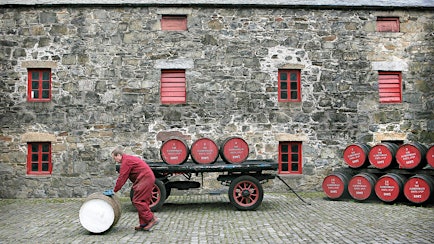
Aging allows for more choices. French brandies are typically rested in untreated European limousin oak. American brandy makers employ a wide variety of woods, including casks that have previously been used to store whiskey and wine, as well as those that have been treated by charring the wood staves on the inside.
Scott Harris, cofounder of Catoctin Creek, which also makes rye, says he uses a mix of barrels. “Some people say the way we do brandy is the way a whiskey maker would do brandy. And if the shoe fits wear it, because we are whiskey makers.”
It isn’t as though North America is new to brandy. Eastern colonialists, blessed with robust fruit orchards, quickly took to distilling using the fermented juice of apples, pears, peaches and berries. The Spanish did the same with grapes when they arrived in what is now California. New Jersey’s Laird & Company, which makes a variety of apple liquors, started distilling in 1780, so it’s older than the U.S. Constitution. Some believe Johnny Appleseed, a 19th-century nurseryman legendary for planting apple orchards in the Appalachian area, did so as a source of hard cider, not pies.

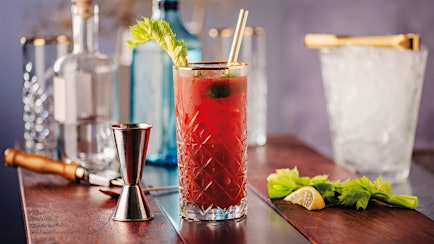
As well as providing eau-de-vies for sipping, the current movement is also a boon to barmen. Forward-tasting brandies seem custom made for mixology as their flavors easily hold their own with mixers. They sometimes have higher alcohol content, such as Gallo’s Argonaut Saloon Strength edition, with its 91 proof (45.5 alcohol by volume). Christian Brothers’ Sacred Bond and Catoctin Creek’s 1757 XO Brandy are both bottled-in-bond, a legal distinction that stipulates it be sold at 100 proof.
While such 20th-century drinks as the Sidecar and Brandy Alexander were invented with Cognac, it’s not as though the notion of brandy cocktails was foreign to early Americans. The first Juleps were made with brandy, not Bourbon, and the spirit found its way into slings, punches and sours. The Jack Rose, made with apple brandy, citrus and grenadine, was considered by drinks theorist David A. Embury to be one of the six essential cocktails, alongside such lofty company as the Manhattan, Martini and Old Fashioned.
Even as larger beverage concerns have taken notice of the movement (Gallo bought Germain-Robin, which began as a craft distiller, and Bourdon Spirits Co. now owns Copper & Kings) raising awareness of American brandy is still an uphill climb.
With a lack of understanding of the product, the market has suffered by comparison with cheaper, inferior products labeled as brandy. You may have been introduced to something called blackberry brandy in college. More likely than not it was really just an oversweet liquid of neutral spirits flavored with blackberry juice, not true brandy. Today, a customer seeing a fine brandy on the shelf might be reminded of such a youthful experience and reject it. Others are surprised by the complete lack of sugar in a product they assumed to be a fruit drink. Harris says that one market segment that grasps the complexities of his products is the baby-boomer who served as a GI in Germany in the 1960s and got to know that country’s tradition for true brandy.
“We at Gallo are advocates for a separate premium brandy definition similar to how you have straight Bourbon,” says Warter. “We would like to see the TTB (the federal government’s Alcohol and Tobacco Tax and Trade Bureau) build on the definition of premium brandy.”
“Members in the American Craft Spirits Association think the federal government missed an opportunity,” says Harris. “They let a lot of garbagy stuff [use the brandy designation]. That would have never been allowed in the whiskey world.”
Another problem is getting people to taste it. Large liquor retailers don’t do much to promote it or explain what it is, observes O’Neill. He says Binny’s Beverage Depot, a large midwestern retail chain, is a notable exception as the owner Michael Binstein has brandy experts on staff.
The recent pandemic put a crimp in market growth as well. “Covid hit and people went to the tried and true,” says Warter. “They weren’t out in bars having bartenders say ‘hey, try this.’ ”
One tool to raise awareness among the public is transparency. Argonaut labels list all the grapes and the still types used together with the percentage and age of each component. Similarly, BrandyLab reveals the age range and the types of casks used in compiling its product.
Harris notes one bright spot. Recent tariffs have boosted the price of European products to American consumers, making American brandies a bargain by comparison.
Whatever the current market climate, producers are still intent on creating great brandy domestically. Warter explains that for Gallo the spirit has never been a spur of the moment thing. Rather, it is something that has been building since the late 1970s when founder Julio Gallo and his son, Bob, started laying down the best of their lots. “Bob Gallo has told me, ‘My dad used to say that someday the United States is going to love brandy as much as I do—and we’re going to have the brandy ready for the day when it comes.’ ”