Drinking A Toast

The legend goes that Bourbon was born in 1789, when Elijah Craig, a Kentucky minister who didn’t find any theological contradiction with also distilling whiskey, was cleaning some residue off the inside of a barrel with flames. The vessel caught fire, he dowsed it and then the thrifty Baptist chose not to throw it away. It was still watertight, so he put whiskey in it. When Craig subsequently tasted the batch, he was pleasantly surprised to discover that the charring had aged and improved the spirit faster than normal.
Historians may point out that the story has more holes than the Pirates’ outfield, but like any good myth it serves a purpose. The legend explains how charring a barrel gives Bourbon its distinct notes of oak, vanilla and caramel, as well as the deep color. And today, among the legal stipulations of the whiskey is that it be aged in new, charred-oak containers (along with a corn-rich recipe, purity standards and age requirements). So, it would seem the last word had been written on how to get flavor from a barrel.
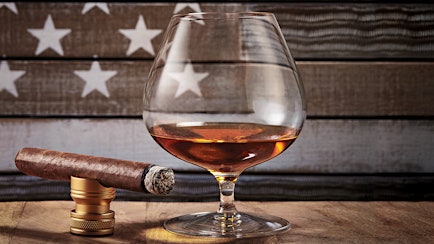
But no. A new approach to treating oak barrels is emerging, one that involves toasting as well as charring the wood. It opens up the possible flavor spectrum to chocolate, nuts, coconut, toffee, cinnamon, nutmeg, mint, even salty and floral hints as well as (of course) toast. And the trend is a boon to smokers who delight in pairing cigars with whiskey. Sweet Bourbon is already a great partner for tobacco, but toasting’s lighter touch creates options that are tailor-made for finding the subtleties in milder smokes.

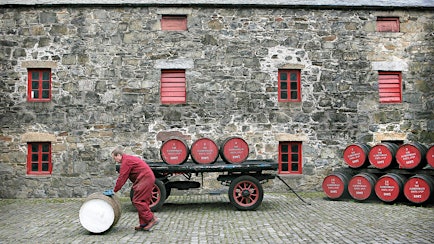
So how does toasting differ from charring? The standard charring procedure is that after building a cask, the cooper sets the inside on fire for anywhere from 15 to 55 seconds, with a level of char from one to four, four being the most intense. It helps the whiskey to seep into the wood, where it obtains most of its flavor and is naturally filtered during the years in which it matures. Toasting is a subtler treatment, more akin to spit-roasting meat than flame grilling it. The wood is heated, but never catches fire, coaxing such subtler flavors from the oak as toffee, coconut and spices.
For such whiskeys as Bourbon and straight rye, toasting does not replace charring (as it is mandated as part of the process). Typically, toasting comes at the end of the aging process when whiskey that meets the legal standard is finished for a short time in containers that have been toasted but not charred. Scotch makers use the same process when they finish aging in repurposed Sherry and Port casks.
Michter’s is considered a trailblazer in toasting, having introduced its first such Bourbon expression in 2014. It’s since offered straight rye and sour mash whiskey as well as Bomberger’s under a separate imprint. However, the distiller’s master of maturation Andrea Wilson allows that the process didn’t spring to life fully formed. “Winemakers have been toasting barrels for a very long time,” she says. “Furthermore, we naturally season and air dry all of our wood for at least 18 months, but sometimes up to five years, and then we always toast before charring.” Toasting releases lactones from the wood’s lignin layers that can be detected even after the charring stage.
“It’s just like toasting bread,” explains Conor O’Driscoll, the master distiller of Heaven Hill, which makes toasted versions of both its Elijah Craig Bourbon and straight rye expressions. “It’s kind of more gentle heat over longer periods. The barrel is put over this electric heater. It radiates heat into the barrel and toasts. What you get are the wood sugars, which is, you know, one of the reasons why oak is used to age Bourbon, because it’s all those delicious, sweet notes when the wood sugars caramelize. Toasting extends deep into the wood and the whiskey pulls out lots of rich caramel, butterscotch notes.”
He describes an involved testing period before Heaven Hill landed on just the right process for treating its first toasted product. “Independent Stave [a company employed by Heaven Hill as its cooperage] came up with three different prototypes of specific toasting protocols, if you will, so different temperatures and different times to accentuate certain flavor notes that are in [the standard] Elijah Craig,” he says. “[One barrel] just hit it. We felt like it played best with Elijah Craig, with the original Elijah Craig product.”
The irony, of course, is that the whiskey is the namesake of the aforementioned Craig of the charring, not the toasting, legend. Nevertheless, O’Driscoll says that Heaven Hill has a long history of innovation, of “flexing its inventory” to discover new ways to make whiskeys.
Wilson stresses the importance of strong relationships with coopers, of which Michter’s uses several, sourcing its wood globally. “Cooperages play a significant role in creating consistent, repeatable production of the barrels to achieve the results that we expect over time,” she says. Trust in the cooper’s skill is not such an issue because you can look at the wood and see it has been treated as ordered, she observes. “But toast you can’t see, so we have no idea whether it was done to specification or not. It’s a very important skill. It requires time and attention to detail, and in many cases, they’re using technology to really dial in those temperatures and a consistent amount of time to ensure you get consistent, repeatable toasting processes. And so, it’s a tremendous honor to recognize the skill of these cooperages and what they’ve been able to achieve in terms of unlocking the real beauty of the wood.”
In Michter’s case, as well as being toasted after the barrel is constructed, the wood has undergone a five-year air-drying process, which also includes toasting. Wilson says that this is true of the casks for all Michter’s products.
She recalls the time when the first toasted Michter’s was created. “Many producers were doing finishes in Sherry barrels, Port barrels, rum barrels, essentially, barrels that previously held another product,” she says. “To us that was interesting, but our team worked so hard to create our Bourbons and rye products, there’s a lot of passion that goes into the production of those products. It didn’t make sense to us to influence those products with another spirit. So, we thought, well, let’s talk about doing something different. And we thought, gosh, the toasting process yields so many different extractive, extractable compounds from the wood. Why don’t we just do a toasted-only barrel finish?”
The development process for Michter’s was much the same as it would be at the end of the decade for Elijah Craig, Wilson says. “We took our Bourbon after full maturity, we dumped it, or disgorged it, and then put it back into a toasted-only barrel with no char. And we tested that many times after days and days. And you know, we just kept taking samples. And then at one point we were like, ‘Oh no, we’ve gone too far.’ And then we backtracked to dial in where we felt that second toasted-only barrel had the most beautiful influence. And that resulted in our first release of toasted-barrel finish Bourbon.”

Not surprisingly, the craft-distilling world has explored the process, albeit with limited geographic distribution. Examples include Barrell Vantage Bourbon, Buzzard’s Roost Toasted Barrel Straight Rye, Daviess County Lightly Toasted Bourbon and Penelope Toasted Barrel Strength Straight Bourbon.
A two-pronged approach defines another whiskey in the toasted arena: Basil Hayden Toast. The normally rye-forward entrant in Jim Beam’s Small Batch Collection uses an alternate grain recipe that contains brown rice in place of rye. The master distiller Booker Noe, a grandson of Jim Beam, had initially experimented with rice as a secondary grain for Bourbon decades ago. (The law specifies that corn must be in the majority, but makers can fill the bill with their choice of grain. The defaults are usually rye and barley.) Noe’s grandson Freddie Noe, who is now a master distiller, used the mash bill when Beam launched its toasted product in 2021. The two factors combined to deliver a mellow, less spicy, slightly sweeter flavor and a smooth mouthfeel, says Tim Heuisler, the global brand ambassador.
The process includes a primary aging in barrels charred to the highest level (four), then a secondary maturation in toasted barrels to draw out notes of caramelized sugar and toasted wood. The Bourbon is then mingled with additional brown-rice Bourbon that has been rested solely in char-level-four barrels.
Within the Small Batch Collection, Basil Hayden, at 80 proof, is promoted as refined, yet approachable in a group that includes the high-test-and-impossible-to-ignore Booker’s. Heuisler says that Toast version of Basil Hayden was an opportunity to innovate with the coy whiskey while staying true to its roots. “The use of toasted barrels has been a game changer for us regarding flavor development. We like to say that distillation is the science and that maturation is the art when creating a new product.”