Sailplaning
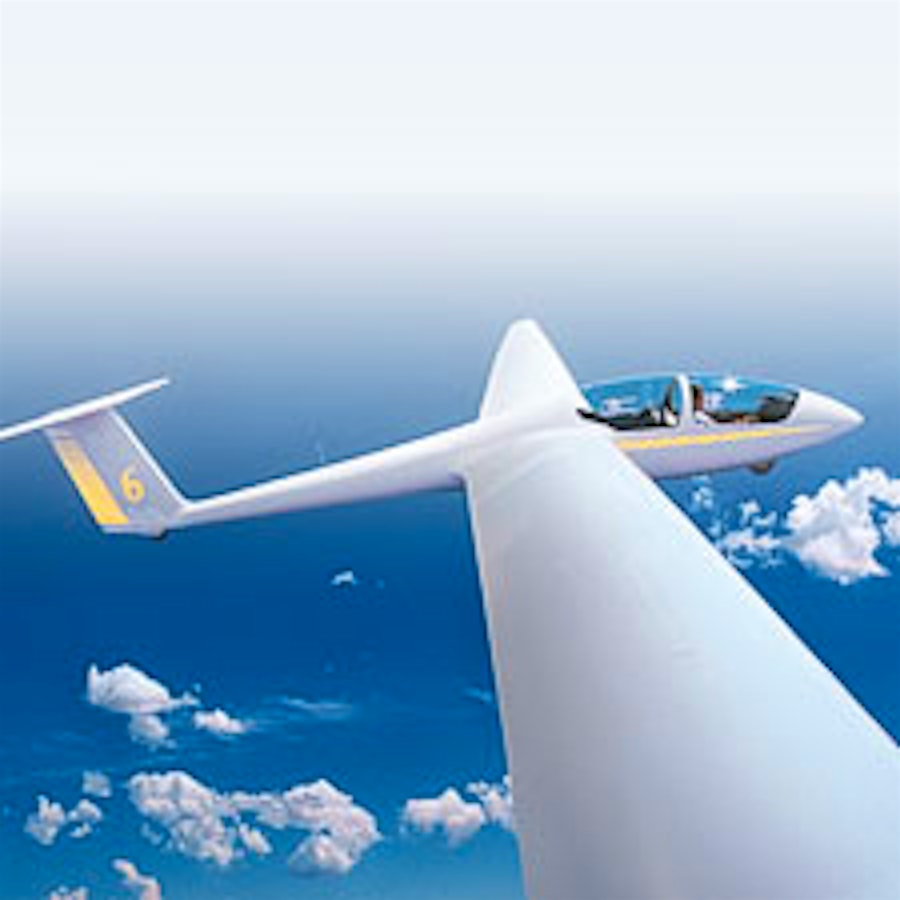
I'm 3,500 feet in the air in a plane with no engine. The cornfields below me have morphed into green and gold puzzle pieces, Houston's skyline shimmers in the horizon, and about a mile in front of me, a hawk flies in a lazy circle. "Follow that hawk," says Russell Millar, a member of the Greater Houston Soaring Association and my lone companion on this two-seat glider. "Hawks know where the thermals are."
And so I grab the control stick and steer us toward the bird, seeking the spirals of rising heat that allow the feathered fellow to soar without growing tired and my 900-pound plane to stay aloft without a motor. I'd like to say I'm confident at this moment, but my heart is banging around in my chest and my palms are so slippery I'm about to lose my grip on the stick. I'm in that bizarre state I call euphoric fright—I'm terrified of nose-diving, but dreading the moment Millar says it's time to land.
Flinging an engineless plane into the air is a surprisingly easy task: you tie a tow line between your glider (also called a sailplane) and a converted crop duster, and at 2,000 feet, you release the rope. To steer a glider is equally primitive—you just keep an eye on the strand of yarn taped to the plane's front window; it tells you whether you're flying straight or crooked, as if it were a compass from the Dark Ages.
For all its simplicity, a glider can carry you a heck of a long way.
Cross-country pilots regularly travel 600 miles in one flight, reaching speeds of 150 mph and heights of 20,000 feet or more. They simply hop from thermal to thermal, catching a lift and then moving right along. Of course, this is most easily accomplished in hot, dry states like Texas, but nearly every state has its own soaring club. Most pilots land their planes in the same small airfields in which they started, but those traveling cross-country have been known to touch down anywhere from plowed pastures to football stadiums.
To take a glider trip, you'll want to get in touch with the soaring club nearest you and ask what kinds of introductory flights they offer. (The Soaring Society of America has a good Web site.) Glider pilots are a famously generous bunch, anxious to show newbies how to soar the skies the way birds of a feather do. Even if, like me, you're nowhere near as brave as a hawk.
Visit ssa.org.