Japanese Knives
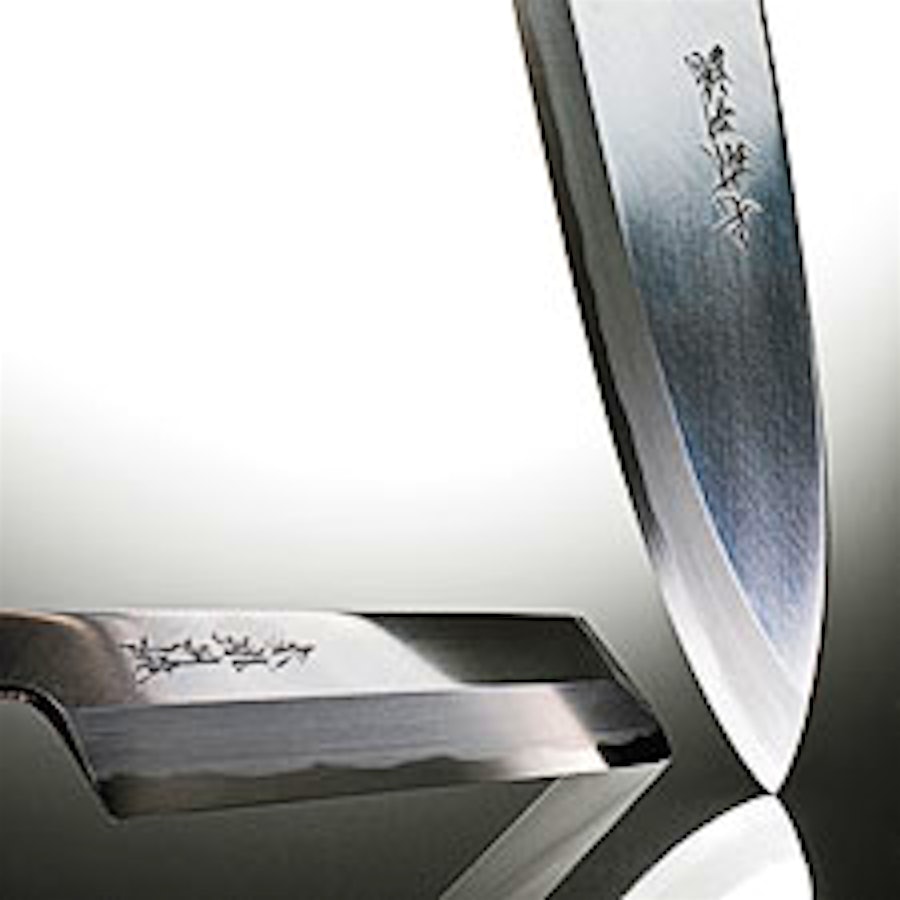
When Japanese Imperial rule replaced the samurai-dominated Tokunaga Shogunate in the nineteenth century, the swordsmiths who turned out the famed samurai katana, discovered an opportunity. They honed knife crafting skills. Japanese cuisine blossomed, literally. The long fugubiki allows chefs to slice fish so thin that pieces can be shaped into flower petal designs, or produce translucent filets where the artwork on a plate shows right through the fish.
A straight, single-edge blade (slightly concave on the opposite side) achieves the fine cuts. The smaller reverse edge on the Japanese knife's opposite side makes for durability and extends edge life. In general, Japanese knives tend to have a sharper but more delicate edge than western cutlery.
"The traditional Japanese knife is very purpose specific," says Jun Hashimoto, General Manager at Korin, a New York-based trading company, which imports knives from Japan. The fugubiki and yanagi are long, thin sashimi/sushi knives. A variation on the yanagi is the takobiki (octopus knife) with a distinctive blunt end. It is used by Tokyo sushi chefs, who do not wish to threaten with their bold strokes the diners to whom they work in close proximity. The deba knife is for filleting fish and boneless meats. Usuba knives, which bear a passing resemblance to cleavers, are used for slicing and dicing vegetables. Wielding a sharp usuba, a skillful Japanese chef can peel a daikon radish into a thin parchment-like sheet, a style known as katsuramaki.
Skilled smiths, gauging the color of fire and hue of red hot metal, forge traditional knives from shiro-ko ("white steel") and ao-ko ("blue steel"). These knives, known as kasumi (misty) for the "feathered" mid-blade strip are made by combining carbon steel and soft iron.
Western cooks will find a yanagi is ideal for preparing carpaccio or the thin seafood slices a ceviche requires. A usuba vegetable knife in the hands of a pastry chef makes precise cuts in chocolate truffles and sponge cakes.
The single-edge blade requires some adjustments. For example, the edge must face down when making horizontal slices. Left-handed knives can be ordered.
To achieve extended kirenaga (duration of sharpness) takes advanced sharpening skills. Chiharu Sugai, who studied for three years under a master sharpener, offers free lessons at the Korin shop.
The key to sharpening? Sugai answers, "Overcoming fear." Those blades can really cut. But he quickly adds, "One week and the fear is gone."
Visit korin.com and japanese-knife.com.