Formula 1 Hits The Strip

Days before the $15 million McLarens, Benzes and Ferraris would turn the Las Vegas Strip into a racetrack, Sin City bookies have already revved up. Engines are scrutinized, racers’ psyches analyzed, tire grips dissected. All in the name of creating odds for the upcoming Formula 1 Las Vegas Grand Prix.
The international racing circuit’s second Vegas stop in two years seems a symbiotic natural. Formula 1, while immensely popular around the world, is only lately making inroads into the United States. And what better place to promote a jet set sport to the country? Las Vegas is uniquely qualified to take advantage of the gambling it inspires.

Working a global sport—24 races in 21 countries, ranging from Brazil to Monaco to Bahrain—some of the oddsmakers are predictably not in Vegas proper. From far-flung locales, they handicap the chances of high-speed superstars like F-1 championship favorite Max Verstappen, lead-footed Lando Norris and fast rising Charles Leclerc taking various places over two nights of racing and one devoted entirely to practice runs.
Operating out of Cyprus in a seemingly windowless room with no shortage of flat screen TVs, Chris Pearce, senior trader at Caesars Sportsbook, is making lines for Caesars Entertainment as more than 1,000 F1 employees and race team members descend onto Vegas. “It is very much a sport of nuance,” he says of the race that was poised to take place 7,100 miles away from his headquarters. “Last year in Vegas it was a two-person race—between Verstappen and Norris. Now there are eight drivers who can realistically win any race at any moment.”
Chief among them, he ticks off, are the veteran superstar Lewis Hamilton and “multiple champion George Russell, a very talented driver as well. Then you have your two Ferrari drivers, Carlos Sainz and Charles Leclerc.”
Out of all those, who seems likely to win? “Well,” Pearce demurs, “it’s a very competitive playing field.”
In fact, as race time nears, Sainz, Leclerc and Russell are the bookies’ front runners for the first three positions.

But what of Verstappen? It’s worth noting that he might be gunning for something bigger than a single win. “If he finishes ahead of Norris, he’ll have the [season’s] F1 championship,” says Pearce. “For that reason, I can see him driving a more defensive race. Maybe he won’t take chances and push for an overtake.”
Gamblers with plans to wager into the lines of Pearce and his casino compadres are not sitting idle. In Vancouver, Canada, Gabriel Morency, a sharp handicapper of F1 and host of the podcast SportsRage, sifts through a smorgasbord of bets. Likening F1 to horse racing, he says, “You can bet on who’s going to win it outright, you can bet on the first three finishers, you can bet on who will have the fastest lap, which is fun to do, because then you are in action right until the end of the race. You can bet on who will finish fifth or sixth.”
That a slice of the drivers are, for all intents and purposes, out of the money, while others are unlikely propositions, is not a negative for a guy like Pearce. “It’s actually one of the better sports to wager on,” he says. “People bitch all the time about F1 being predictable. But if you’re a gambler, what’s better than predictable?”
In Las Vegas, a place that does nothing by half measures, hotels are packed for the big weekend in November, restaurants go over the top (Carver Steak offered a tasting menu with foie gras, Wagyu carpaccio and its special F1 striploin), jetsetters drop in, gamblers pony up for their wagers that set records in some casinos and lag against the previous year in others. Whatever the case, the game is undeniably on.
Every casino did its part to make an F1 statement. Fontainebleau loaded up with a collection of 20 vintage Aston Martins, valued at $18 million; Resorts World had a high-speed go-kart track and one-day food festival put on by LA-based Industry Only specifically pegged to the race. Downtown at Circa, far from the vroom vroom, gamblers soaked in a heated pool, placed bets at the adjacent sports book and sweated the race via a 143-foot screen that dominates the casino’s Stadium Swim.
For people who feel compelled to be where the big noise is—whether it’s Art Basel in December or the Super Bowl in February—Vegas on F1 weekend is a must stop on the Spectacle Circuit—even for those more into spectacle than sport. At the wine-centric Wally’s in Resorts World, Charlene Woods picks at a pricy salad while explaining her reason for pulling funds from a freshly plumped cryptocurrency account and chartering a private jet from Los Angeles to Las Vegas for this weekend.

“F1 is among the best events in the world,” she says, as if it is all so obvious. “F1 has amazing cars, amazing brands, corporate people, amazing nightlife and gambling. It has all the elements. I’d rather come to Vegas than anywhere else for F1.”
Upstairs in the clubby Alle- Lounge, on the 66th floor of Resorts World, Guy Laliberté, billionaire founder of Cirque du Soleil, could not agree more. He is putting on a high-stakes poker tournament to benefit his One Drop Foundation charity, which brings clean drinking water to places that lack it. The buy-in is $12,500 and familiar faces include Phil Hellmuth, Jennifer Tilly and Antonio Esfandiari. Sprinkled among the card players: such racing royals as Martin Brundle and Alex Wurz.
“A lot of my friends are in town for the race,” says Laliberté, out on a balcony that overlooks Vegas, just a nip away from where the cars will soon compete. “So, this is a good weekend for doing the tournament. It’s a big weekend in Vegas and an opportunity to raise money for One Drop.”
Minutes before cards go in the air, he looks around at the pros in the room and confides, “First hand, I’m going all in, blind, just to set the pace for things.”
Since the tournament has unlimited rebuys, it will give him a chance to raise extra money for his charity, assuming at least one player calls his bet. Two do; one wins, Laliberté and the other loser both rebuy. Looking victorious, the circus magnate who got his start as a mime loudly declares, “Twenty-five thousand for One Drop!”
On a weekend like this, of course, even a deep-pocketed tournament is just a sideshow.
The raison d’etre for being in town is the race itself. Never mind that the sport is so new to them that most Americans find it hard to fully get a grip on the racers, the action and what to look for when handicapping. To the last bit, Morency has a few thoughts: “You can handicap crashes. You can handicap weather. You can handicap tires being used in the heat or cold.”
And it also should be noted that Vegas, for all its high-profile glitz, is not a favorite stop for the F1 drivers. Some don’t dig all the attention. “I’m not a fucking zoo animal,” one driver is said to have griped last year. And the track comes with its own peculiarities. “It is very tight,” says Pearce. “There are a lot of slow speed corners. It’s a tricky track to drive on if you don’t have the experience there.” Since this is only the second Grand Prix in Vegas, no one really does. “Plus, it’s a nighttime race.” That means the glow of the Strip—not to mention the massive distraction of The Sphere—must be dealt with. “The vast majority of races [in other locales] are daytime. So, that’s something to adapt to.”
It’s also something to add to the list of handicapping points.
Like it or not, the racers are here, and they draw the kinds of customers who Vegas bosses love the most: Those with the cash or the connections to make it inside the F1 Paddock Clubsearch, a 300,000-square-foot, four-story building constructed strictly for F1. It serves as Grand Prix Central and a hub for attendees in the know. It’s where the cars have their high-tech garages that open onto pits for mid-race primping and repairs.
Most important for Vegas, it’s also where the top casinos establish a presence. Heralded spots like Wynn, Venetian, Fontainebleau and MGM all have hospitality suites for the big players who get flown into town and rewarded for their gambling ways. They receive elite perches from which to watch the race. LIV, the Miami nightclub with an outpost in Vegas’s Fontainebleau, even transported its club to the Paddock. The racy version of LIV comes complete with a rotating crew of elite DJs and a dancefloor that lights up for those who need a break from the 233 mile-per-hour action.
Celebrities like Paris Hilton, Justin Bieber, Diplo, Brad Pitt and Emily Ratajkowski wander through the Paddock as if they are in search of a red carpet to tread across—with most of them dressed the part, decked out in designer finery. As Renee Wilm, former CEO of the Las Vegas Grand Prix, is quoted as saying, “It’s the perfect marriage of speed and glamour.”

Maybe most glamorous of all, according to a source who asked not to be named, is a move put on by a guy who happens to own eight Bugattis. “He’s going to drive on the track, after the final qualifying session,” the source says, adding that he’ll be joined by an elite cadre of fellow Bugatti owners. “They spend $90,000 for the weekend and that comes with the package.”
Off the track, up in the Paddock, drinks and food flow freely—lamb chop lollipops, pillowy sushi, juicy burgers—and whatever sounds filter up from the track below are punctuated by the popping of Champagne corks in Fontainebleau’s suite. Fans wear racing colors and root appropriately. One woman, who travels the international Grand Prix circuit, makes a statement by wearing a leather Ferrari jacket, accented with a belt made from tiny F1 cars.
It’s not all about the racing action. With a 3.8-mile course, it takes a couple minutes for cars to roar by, disappear, and reappear over the run of 50 laps. The spectacle comes in spates of watching the race, then nipping into the suite for a cocktail, then back out to view the cars speeding through. There’re also moments to talk and schmooze it up with others in attendance. It feels like a cool cocktail party with something exciting to sporadically watch and gamble on.
It’s no surprise that casino bosses are present in their respective hospitality dens. For them, a parallel game takes place in their count rooms and accounting offices. Las Vegas ranks F1 as something of a saving grace. Fast cars salvage a traditionally slow stretch of the Vegas season: the weekend before Thanksgiving.
Maurice Wooden, the president of Fontainebleau Las Vegas, takes it all in from a corner of his lush hospitality digs. Entertaining a small group, he looks pleased with the night. “It’s a hot weekend in Vegas,” he says. “F1 adds a base of 100,000 to 150,000 people who want to be here for the race. It definitely attracts the higher profile gamblers. And Vegas offers multiple experiences on top of F1. The appeal of doing a lot—dining out, going to the spa, gambling—and then going to the event is a big deal. It is very helpful on the gaming side.”
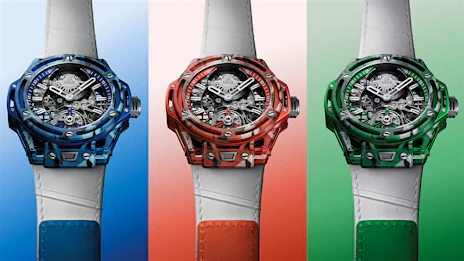
Indeed, on race weekend, the city swirls with high rollers from around the world. From a casino perspective, F1 also offers opportunities for corporate partnerships. Wooden and his Fontainebleau crew capitalized on that. Beyond rounding up the Aston Martins, there are corporate events—like one that pairs the luxury watch company Hublot and the high-end Volcan Tequila for a cocktail-party/watch-viewing at the casino’s elegant Azul bar—that made the most of the Vegas spenders.
After the final car passes the finish line, there is a bit of suite hopping, which leads to drinking and elbow rubbing in the Venetian’s spot. It’s there that Patrick Nichols, CEO of the casino, offers to take a group down to the garage where the auto produced by France-based Alpine is going through its post-competition paces.
The pink-bodied racer is disassembled and opened up like a patient in the ER. A tech guy focuses on a computer screen and the car’s high-tech components. At least a half dozen mechanics are all over the beauty, some underneath, others on top, a couple dismantling the headlights. When a spectator ventures too close, he’s shooed away from the vehicle that has some 15,000 parts and a gearbox worth about $350,000.
And that’s just the beginning. As Gabriel Morency maintains, “They put $150 million to $200 million of R&D into these cars.”
It’s a rich sport for rich people. At Resorts World, after the race, Ian Florenza, general manager of Eight Lounge, recalls his place being loaded up with members of the Ferrari club. “People who love super cars love the good life. And part of that is enjoying fine whiskey, fine wine, fine cigars,” he says. It’s a specialty at Eight, where single-malt Old Fashioneds are delivered in smoke-filled cases. “It all ties right in.” So much so, he adds that “we actually ran out of Macallan right at the end of the night. It was a good problem to have and good timing.”
The race proper is basically a two-day affair, coming after a Thursday session devoted strictly to practicing. In Vegas, the tires begin screeching for real on Friday night with a qualifying round. Twenty racers from 10 teams hit the asphalt, race past the familiar marquees of Bellagio, Caesars and Cosmopolitan while competing for a slot in the final race one night later. Only the top 10 finishing racers make the cut.
Saturday night’s race is viewed from balconies that line Giada, the Italian restaurant inside the Cromwell, which is owned by Caesars. The food is excellent, with lemon pasta served from inside a wheel of Parmigiano and knockout Chicken Milanese. The venue affords excellent views from the balcony (some attendees pay $500 to be there; many are comped) and plenty of TVs for tracking the action.

Diehards, a high number of whom are in from out of the country, and surprisingly not betting on the race, spend much of their time watching the TV screens. “It’s mostly to be in the environment,” a Brit says after negatively analyzing a punter’s half-dozen wagers. (He is right; only one of the bets come in, and it pays off at tragically short odds.) “But I need to watch the cars as they come through. I need to know what Hamilton is doing. I think he might win it tonight.”
And, yes, when the cars near the corner of Flamingo and the Strip, he hops up and zips over to the balcony, with his hapless girlfriend in tow.
“People who seriously follow the sport are there because they love the cars, they love the sounds,” says Morency, confirming that for the diehards, betting is secondary, if it exists at all. “There is nothing like it.”
After the cars crossed the finish line on Saturday, George Russell, one of the favorites, took first place from behind the wheel of his Mercedes. Fellow Mercedes man Hamilton (who moved to Ferrari in 2025) finished in second, and Ferrari’s Carlos Sainz snagged third. Fans stayed to enjoy the aftermath, sipping Espresso Martinis to get them through the night.
Verstappen rode through in lowly fifth place, pretty much as the bookies predicted. But first in this race was not what he came for. The apparent plan for him was simply to go easy on the risks and to beat archrival Norris, which would reward him with his fourth championship. That ambition, forsaking first for something more important, may have skewed the outcome—and no doubt screwed up bets for neophytes who thought they were getting a bargain with unusually profitable odds for Verstappen.
Even with losing bet chits turned to confetti, Verstappen, no doubt, is just beginning his celebration. And he does it in the most Vegas way possible—slipping into the backseat of a Rolls Royce Phantom, complete with a lit-up map of the solar system on its roof, and getting chauffeured to the Bellagio. It’s a path, and a mode of transport, that is classic for many a big player.
After his speech and accepting an award in front of Bellagio’s iconic dancing waters, he deals with Formula 1 responsibilities until the wee hours. In the wake of it all, Verstappen admits to the Times of London that hitting the clubs stone sober when all other revelers are wasted would be a bit of a buzz kill.
But it is no worries for the champ. His friend Martin Garrix, one of the world’s top DJs, spins for a private party that Verstappen puts on in a hotel suite for him and his retinue.
“We had a great time all together,” he tells the Times, going on to maybe downplay the night. “Just having some drinks and laughing.”
Soon after, though, the jollity dies down, the music stops, and it is off to Dubai, for a fresh round of competition in a sport where nothing slows down for very long.