2011 Big Smoke Saturday Seminars: Top Three Legal Cigars of 2010 Tasting
Halloween
weekend in Las Vegas can be described as a combination of Mardi Gras,
Carnival, and some spooky pageantry. Its casinos are full of characters
whose costumes range from the surreal to the sexy and its vast atriums
are decorated in welcoming autumnal colors, warmed by a theme of
harvest—and the smell of cigar smoke, thanks to Cigar Aficionado
magazine’s 16th annual Las Vegas Big Smoke celebration.
The
event came early this year to the Venetian Hotel, coinciding with one
of Vegas’s most festive weekends, though Big Smoke loyalists were not
deterred. Celebrity parties up and down the strip mean nothing to a
cigar enthusiast when so many industry luminaries and cigar lovers
converge as they do at the Big Smoke weekends.
The
seminars, which are the perfect balance of the academic and the
recreational, began at nine o’clock Saturday morning, where each
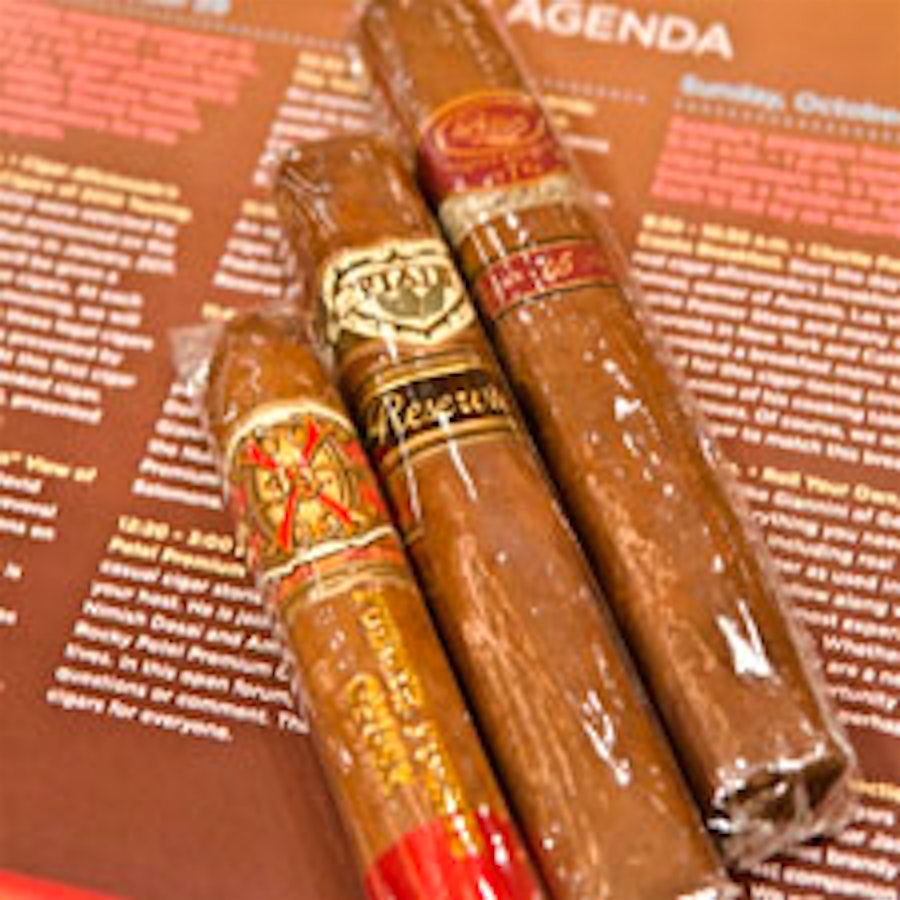
attendee was handed a Humidipak bag containing our top three non-Cuban
cigars of 2010. For a cigar lover, this is a particularly exciting
offering, as many Big Smoke guests live in areas where these cigars are
exceedingly difficult, if not impossible, to obtain.
Some
guests lit up their smokes as soon as they got them, unable to contain
themselves for the introductions. Who could blame them? A Viaje Oro VOR
No. 5 Reserva, the Fuente Fuente OpusX XXX Belicoso, and the Padrón
Family Reserve No. 45 in its natural wrapper were numbers two, three and
four, respectively, from our 2010 Top 25 list. Each had rated 95 points
in that tasting, classic on our 100-point scale. As the show began,
executive editor Gordon Mott took the podium to introduce the cigars and
their makers.
“Twenty
years ago this month I was sitting in my office and Marvin Shanken
walked in and said ‘How’d you like to work on a cigar magazine?’
Honestly, I thought he was just having a bad day. I mean, a cigar
magazine in 1992? We were in a sort of mini recession and the
anti-tobacco folks were on a rampage. Nine months later, the magazine
was in a warehouse in Chicago waiting for shipment to the first RTDA we
ever attended. Here we are 20 years later, and I have all of you to
thank.”
Mott went on to introduce the first cigar of the morning, Viaje’s Oro Reserva VOR No. 5, the No. 2 Cigar of 2010.
“Smoking it was one of those revelations. It was like ‘Wow, what is this?” said Mott. “I had never heard of it.”
The brand is owned by 33-year-old Andre Farkas, who started the company in January of 2008. After a brief but memorable stint in cigar retail, Farkas realized that his career as a talent agent in Los Angeles was unfulfilled and yearned to be back in the tobacco business, explaining his dissatisfaction with the entertainment industry: “If you didn’t give up your entire existence to the job,” he said, “there was no chance for success.”
By 2008 he started the Viaje brand, which means “journey” in Spanish. “It seemed like a word that most could relate to.”
Originally
produced in the Joya de Nicaragua factory, Viaje is now made at Raices
Cubanas in Honduras and the Oro Reserva was part of a small-batch
production.
“Being
a small manufacturer gives me tremendous freedom to be creative, to
control quality and to be nimble as a company. I can change directions
at a moment’s notice,” said Farkas. The audience listened as they smoked
his cigar, which is a blend of Nicaraguan tobacco from different
growing regions. A Corojo ’99 wrapper covers a double binder of Corojo
and criollo around filler tobacco from the country’s three major growing
regions, Jalapa, Condega and Estelí.
The
Viaje Oro VOR No. 5 gave smokers something to enjoy during the next
seminar, which focused on Cuban cigars and the U.K.’s retail market.
When that seminar concluded, Cigar Aficionado’s senior editor David
Savona introduced Carlos “Carlito” Fuente Jr., and his Dominican puro
cigar.
“I invite you to light up the Fuente Fuente OpusX XXX Belicoso,” said Savona, “Cigar Aficionado’s Number three cigar of 2010.”
Fuente
came to the stage and said, “I’d like to light up my cigar because I’m
only half a man without it. To us, the most meaningful things are
friends and family, and each and every one of you are not only my
friends, but an extension of my family.”
He
then called his sister Cynthia, his daughter Liana and Wayne Suarez up
to the stage for “support.” Approaching the 100th anniversary of his
company, Fuente gave an emotional retrospective of his family’s history.
Rather than talk about his Dominican-made cigar, he paid tribute to his
grandfather, who emigrated from Cuba to Florida, and all his struggles
while making cigars, first at the Gato factory in Key West, and then on
his own at A. Fuente in 1912 in Tampa Florida.
Fuente
also painted vivid pictures of life in Ybor city and the cigar industry
before the revolution. “In the 1920s, Tampa, or Ybor City, had more
than 200 factories making 500 million cigars made with Cuban tobacco,”
Fuente said. “It was a community where in every corner, there was a
cigar factory.” Fuente also illustrated the plight of Cuban exiles
forced to leave their homes and establish their trade in other countries
and gave thanks to Cigar Aficionado magazine for reinvigorating the
industry.
|
“This
cigar got a 95?” said Fuente holding up his OpusX. “If it was three
inches longer it would have got at least three more points,” he said
jokingly. “One thing I’ve learned is that everything is family. You need
their strength and support. You cannot achieve anything alone.”
A
round of applause segued into the next seminar on hybrid tobaccos,
after which, Gordon Mott introduced the number four cigar of the
Year—the Padrón Family Reserve No. 45 natural made in Nicaragua. But due to the unexpected and unrelated deaths of two Padrón employees in Nicaragua, Jorge and José Orlando Padrón, who were scheduled to speak, could not
attend, so the audience lit up the smokes (which were in their packets)
in the Padrón’s honor while Savona and Mott spoke about the cigars.
“Of
the seven Cigars of The Year that we’ve had since we started that
award, they have won three of them and have never finished out of the
top four,” said Mott. “To me, it’s just a statement of what they
themselves say. They want quality over quantity.”
At
one time, the Family Reserve was commercially unavailable, reserved
only for events where a family member was present. Then in 2009, the
Padróns introduced it to the general public.
Cigar
Aficionado smoked the No. 45 in a natural wrapper over the course of
2010. Its original high score qualified it to become a finalist for the
Cigar Of the Year and the smoke did progressively better, rising in the
ranks until achieving the number four spot.
“Jorge
is very cagey with details,” said Savona. “I ask him what’s in it and
he says ‘Oh, you know, I make my cigars you write your stories and
that’s all you really need to know.’ He does tell me that he puts old
tobacco in here. Think back to where you were 10 years ago because
that’s when some of the seeds for this tobacco were planted. You’re
smoking some of the oldest tobacco from the Padróns. These guys love
tobacco and take great care to make great cigars like this one. I hope
you enjoy it as much as we do.”
There’s
no set rule as to when audience members should smoke certain cigars.
Some follow the show, smoking the cigars when they are introduced,
others just smoke whatever looks interesting, and others are so
impressed by the rarity of their packet that they don’t smoke them at
all, but save them for another time.
Regardless,
the three cigars of the Saturday seminars were a diverse representation
of the industry and the perfect score to a day of tobacco education,
and, more importantly, enjoyment.
Big Smoke Evenings
2011 Big Smoke Evenings, Las Vegas
Big Smoke Saturday Seminars
Top Three Legal Cigars of 2010 Tasting
An Insider's View of Cuba Today
Today's Hybrids: The Tobacco Used in Your Cigars
Size Matters
Lunch with Rocky Patel Premium Cigar Co.
Big Smoke Sunday Seminars
Breakfast with Charlie Palmer
Roll Your Own, Seminar No. 14
The Cognac Connection