Wrestling With Success

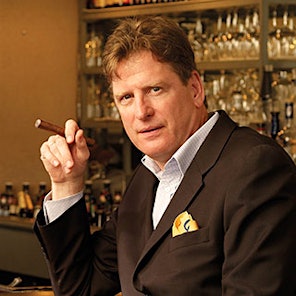
Cody Rhodes is a hard man to ignore. At six-foot-two, he has spiky and perfectly groomed bleached blonde hair, his dark gray suit accented with thick peach chalk-stripes, an orange tie perfectly positioned under his jutting, powerful jaw. His blue eyes are intense, shining with curiosity as he puffs on a dark cigar. The suit might have a little more pop than what you typically see in the boardroom, but if you didn’t recognize him from television he might be able to pass for an executive enjoying himself in a cigar bar.
Unless he’s wearing the belt.
Not a dress belt, but a championship belt. It’s November, and at the time Rhodes is the reigning champion of the World Wrestling Entertainment (WWE), a $1.4 billion-a-year business and the world’s most famous professional wrestling organization. Wherever he goes, the belt is close behind. He calls it “the title,” an accolade once owned by such legends as Bruno Sammartino, The Rock and Stone Cold Steve Austin. It’s anything but subtle: a slab of metal and leather dominated by a pair of massive, bejeweled Ws at its center with a bright red slash on a golden background. It’s even heavier than it looks, clocking in at some eight pounds.

Rhodes is the face of WWE, and unlike many of his predecessors he makes his appearances in a suit and tie, rather than, say, a rhinestone-studded robe, feathered boa or perhaps a tear-away T-shirt. Sometimes, such as today, he opts for a three piece. “My preference is always to be seen in a suit,” he says, a Fuente Fuente OpusX Reserva d’Chateau held in his hand. He takes a practiced puff. “I like all ranges of suits. The top, top dollar, the bottom of the barrel. As long as it looks good.” Of course, most suits worn at work face nothing more dangerous than coffee spills (or, in the case of editors from a certain magazine, wayward ashes). Rhodes sometimes puts his suits through situations no tailor would endorse. Punches. Steel chair attacks. Beatings from a weight lifting belt. He chooses his suits accordingly.
“There are nights where I know we’re not going to get too crazy, so that’s where you can wear the best of the best. Then there are nights when maybe there needs to be a little stretch.” He’s got a guy who handles tears and other sartorial issues. It’s just a part of the business. “If it rips,” he says, “it rips.”
Rhodes won the belt on April 7, 2024, held it for a little more than a year, lost it, won it back in August 2025 and lost it again on January 9. That means it’s not a part of his world anymore. He’s hoping to get it back.
But wait, you’re saying—isn’t this sport fake? What’s so special about being champion?

Professional wrestling has changed considerably in just one generation. When Rhodes was still a toddler—he’s 40 now—grapplers and promoters went to great lengths to insist that everything that went on in the ring was real. Sometimes they went to alarming lengths. In 1984, reporter John Stossel, working for ABC’s “20/20,” was doing an exposé on wrestling when he interviewed a wrestler named David “Dr. D.” Schultz. “I think this is fake,” Stossel said. The far larger Schultz looked as if he had murder in his eyes. His answer included two mighty slaps to the reporter’s head, each one knocking him to the ground. (Schultz was fired; Stossel sued and won.) A year later, champion Hulk Hogan appeared on a late-night show hosted by Richard Belzer. The interview was testy, Belzer irreverent. He asked Hogan to show him some wrestling moves. About 10 seconds later Belzer ended up on the floor, bleeding and unconscious, thanks to a Hogan chin lock. (Belzer sued and won.)
Today, the talent is far less antagonistic with the press. It’s understood and acknowledged that professional wrestling is entertainment, the actions in the ring scripted (or at least planned), the outcome certain rather than surprising. The goal for the wrestler is to put on a good show while doing remarkably athletic feats—and trying not to hurt the other performer while doing so.
“Wrestling, I always tell people, is very real, but not in the way you think,” says Rhodes. “The art of it is making it look like we’re absolutely murdering each other. Really the magic is making it look that way and it not being that way.”
Still, despite the predetermined nature of things, Rhodes says that some of the hits you see are quite real.
“You got to take one on the chin here and there,” he says, matter-of-factly. “It’s HD television. I mean, I’m never going to hit you in an unsafe place: your eyes, your teeth, your nose. But there’s plenty of meat. We can find safe places to hit.”
He points to one of the more common shots in wrestling, a chop, typically delivered across the chest, complete with a very loud slap. “You can’t fake a chop. A body slam in the center of the ring is still a body slam. And the bigger the guy is who’s giving it to you, the farther you’re falling.” Then there are the more extreme things one might see in a wrestling match, such as a person thrown through a table or struck with a chair when the action gets a little . . . spirited. “The tables, God bless them, I wish every fan could take a table. They’d instantly go, alright, never mind.” As bad as that sounds, he says the chairs hurt even worse. “Oh, I’ll take the table every night.” He takes a puff. “When you see those chairs come in, ugh.”

The stakes are high in pro wrestling and missteps can cause serious injury. Rhodes says that leads to copious amounts of respect for your fellow athlete. “I wish a lot of people could experience it just to know the level of sacrifice to it. Big or small. I mean the bigger you are, almost the lighter you have to be because you’ve got a responsibility. If you’re a giant, you can’t squash somebody. You can’t put all your weight on somebody.”
Say you accidentally hit your fellow wrestler too hard or the wrong way, causing pain. That means the person owes you one. In the parlance of the sport, you are owed a receipt. It happened to Rhodes in his earlier days. “I learned a lesson from The Undertaker that blew my mind,” he says. He’s talking about one of the most popular wrestlers of the past 30 years, a grizzled veteran billed at six-foot-ten and around 300 pounds. He was known for a move called the Tombstone, which gave the appearance of driving someone’s head directly into the mat.
“I didn’t realize I accidentally kicked him in the chin,” Rhodes says. He was embarrassed, upset, began apologizing sotto voce in the ring to the older wrestler. “So, under my breath, I’m kind of saying, ‘sorry, sorry.’ Then he just grabbed me by the back of the head and he goes, ‘Here’s your receipt!’ And he said it. And I thought, oh my God, what a nice guy! He told me. And then he just hit me in the forehead.” Rhodes smiles and chuckles. “I love the fact that he let me know.”
Getting punched in the melon is part of the Rhodes family business—or really the Runnels family. Cody Runnels (his real name) is a second-generation wrestler, the son of “The American Dream” Dusty Rhodes, one of the most famous wrestlers of all time, a man who was born Virgil Runnels. Born and raised in Georgia, Cody also has a half-brother Dustin, who wrestled in the WWE under the name Goldust and now works for a competing organization. His nephews Wyatt and Wayne wrestle. Two uncles by marriage are prominent wrestlers: Jerry Sags (one of the Nasty Boys tag team) and Fred Ottman (a rather large fellow who wrestled by such names as Typhoon and Tugboat). Even Cody’s wife, Brandi, is part of the business. A former pro wrestler and ring announcer, she still makes occasional appearances with her husband. They have two children, Leilani and Liberty.

Cody Rhodes was six when his father stopped wrestling full time. “He was 39 when he had me. I didn’t know the wrestling impact and depth of Dusty as a wrestler.” Cody did realize that there was something different about dad. “We had titles in the house. We had bloody photos on the wall, VHS tapes with his face on the cover . . . . He was our football coach, was our Little League baseball coach. And he just was dad. It was other people’s dads who would kind of look at him—wondering who is this crazy man with scars all over his head and his arms, and wearing these Ray Bans that are far too tight for that giant head and bleached blonde hair?”
When Cody was about eight, he joined his father at a show in Chattanooga. Dusty wasn’t wrestling, but he was the booker, the man running the show. “It blew my mind. I’d watch and I was hooked. It’s almost a problem how hooked I was. There wasn’t anything else that interested me.”
Later, young Cody got the full impact of just how big a star his dad was when he watched Sting—his favorite wrestler growing up—walk outside of the arena to an immense ovation. Dusty just smiled. “And he throws his hand across my chest—and I tear up thinking about it—but he told me, ‘oh, just wait.’ ” The reception to Dusty was even bigger. “He walked out and these people lost their fricking minds. And it was older fans just screaming ‘Dusty!’ Chanting his name. And I didn’t know until that moment what he had been as a wrestler.”
On the drive home, Cody started interviewing his dad. He wanted to know everything. Dusty returned the favor, using his son as a guide to see how a younger audience felt about wrestling. “He used me as a litmus test. I’d sit in front of the TV. He’d see who I liked and I was kind of his young market feedback.”
When Cody got older, he and his dad bonded over more than just wrestling. “I would sit in his office right when I was legally able to smoke a cigar—probably before—I would sit in his office and read Dark Horse Star Wars comics while smoking a cigar. And he would talk Texas football. We weren’t doing the same thing, but somehow speaking the same language.”
Dusty Rhodes was an avowed Arturo Fuente Flor Fina 8-5-8 smoker. The old-school size (it was created more than 50 years ago) was his favorite, and various family members would give them to him as gifts. “You weren’t going to go wrong if you just got him a box of 8-5-8s. He was very specific to what he liked.”
Dusty Rhodes died in 2015. Cody Rhodes has his father’s Cigar Dossier, a book in which a cigar smoker can take notes on what has been puffed and place a band as well. “It was incredibly detailed. The bands, the notes, stuff that I don’t think he even meant—notes of cedar.” Rhodes laughs at the final entry of his dad, when he branched out from his tried and true and sampled a cigar he really didn’t like. “Near the end of his life the last entry, and this is very adult, but the last entry in that book was: ‘Sucked donkey dicks—threw it out the truck window.’ ” He laughs. “And that was the last entry. And then my mom gave it to me. I was like, all right. I’ve been using it ever since.”

Just like his dad, Rhodes counts the 8-5-8 as his favorite, but he is a bigger fan of experimenting with various smokes and styles, often using reviews from Cigar Aficionado as his guide. Cigars from the Fuentes are high on the list. OpusX. Rare Pinks. Short Stories.
“I still am a big sucker for walking into a store where it’s got the score,” he says. Smoking cigars not only makes him think of his father, but also his mother, who has family in Ybor City. “My mother is partially Cuban, so the one Cuban thing I do is cigars.”
Before Cody Rhodes turned pro, he had a standout high school wrestling career, as a two-time Georgia state champion. “I was obsessed with it. You ever see the movie Vision Quest? I was obsessed.” Dusty didn’t want to get in the way of his son’s amateur wrestling career, so he would hide in the crowd. “He’d go sit in the furthest seat, covered up, and I’d see him hold the two up for the take down,” Rhodes says. Both his parents were thrilled when he was recruited to wrestle in college. “I got a partial offer to wrestle at Penn State . . . [Dusty] wanted it, and my mom wanted it bad.” But Rhodes feels he was always destined to follow in his dad’s booted footsteps.
“I was just always on the path. He didn’t discourage it, but he was really adamant about letting me know how insanely difficult it would be to be a pro. The sacrifice of the travel. I mean, I understood it, but he also brought me around.” Rhodes first worked in the game when he was only 15, doing a spot as a ref for his dad. “What else would I have wanted to do? My mom wanted me to look, but nothing else appealed.”

When he was 19, he signed a contract with the WWE, the biggest organization in wrestling. He wrestled for a time with his half-brother, wrestled with his dad, was part of a championship tag team, but that initial run with WWE wasn’t the best for him. “The doors open because you’re Dusty’s kid,” he says. “I was given chance after chance . . . . WWE was very competitive at that time, and I just wasn’t ready.” He spent 10 years with the organization that first time, which he refers to as a “feast-and-famine relationship.” He needed a change. “The only thing I could do was split,” he says. “Start fresh.”
He left the organization and went out to smaller, independent gigs where he expanded his knowledge of the business, taking on responsibilities beyond the ring work. He began promoting shows, investing his own money, even took a very public bet against a writer who said he couldn’t sell out a 10,000-seat arena, which he did. “After that,” Rhodes says, “I felt I could accomplish anything.”
He returned to the WWE in 2022. He hadn’t expected to get the call to come back. “I had thought that I burned that bridge.” He also wasn’t sure the fans would embrace him. “I thought I was going to get booed,” he says. Rhodes was a more mature, more complete performer and one who was far more informed about the business. He also had more control over his destiny. “I built my whole character. I owned everything. I owned the American Nightmare logo. I owned the music. All of it was mine,” he says. That was an unusual situation in the WWE, where most characters are company owned. More things were changing in the WWE than just the return of Rhodes. In the fall of 2023, the company merged with the Ultimate Fighting Championship to form TKO Group Holdings Inc., a $21 billion company. Soon after, the longtime owner of WWE, Vince McMahon, resigned as executive chairman amid scandal.
Rhodes returned under a new persona, now known as “The American Nightmare,” a take on his father’s “American Dream.” Despite the menace of the moniker, Rhodes has long been one of wrestling’s good guys, a type of wrestler known as a “face.” Villains are “heels.” Rhodes’ storyline for his first championship run saw him attacked, often quite energetically, by the larger Dwayne “The Rock” Johnson. Rhodes, the perpetual underdog, endured and persevered. The fans ate it up.

Historically, the wrestling business has been hard on the talent, with fewer off days than in most professional sports. Many big-name stars have gone at a fairly young age, including Dusty, who died at the age of 69. Cody Rhodes knows the life is more civilized now than in his dad’s days. “I’m blessed that it’s so much healthier now, in a sense,” he says. For one, the pay is better. “Everyone’s getting paid more than wrestlers were ever getting paid, which means you can take care of yourself more than every wrestler ever. You can have that great nutritionist, have that great trainer.” Travel, long the bane of this industry, is more civilized than in the days when the talent would pile in cars on long road trips. Rhodes only averages about five days a month at home in Roswell, Georgia. He travels on a tour bus, and his family can join him on the road. “My bus is fitted for the girls, so there’s bunks for both daughters, even though Leilani’s just a baby. And then full master setup, so, we live in that thing if we need to. What happens a lot though is when we do big family shows, they’ll take the really nice hotel spot and I’ll park the bus in a campground and just quietly sit there. The tour bus has everything I could possibly need.”
One of those things is a green light for cigar smoking. “You can smoke on the tour bus,” he says with a smile.
Rhodes will be performing at the company’s biggest show, WrestleMania, which will take place in Las Vegas on April 18 and 19. Last year’s event was attended by more than 124,000 people, and its social media reach exceeded one billion views.
He wants the belt back. Bad.

“In the wrestling game you’ll hear people refer to the chase, say chasing is sometimes more valuable than having it—I would not agree with that,” he says. “I’m probably more motivated than I’ve ever been to find out how we get back to the mountaintop . . . You want to have the belt. I don’t like not being champion.”
Will this year’s show involve him trying to get back that big, heavy belt? He can’t say. But win or lose, after the match, he’ll likely be relaxing over a fine cigar.