An Interview With Governor Ron DeSantis

When Ron DeSantis was inaugurated as the 46th governor of Florida in 2019 he was the youngest man to hold that office in 100 years. Reelected in 2022 by a commanding margin, he briefly mounted a presidential bid in 2024. A lifelong resident of Florida, DeSantis was born in Jacksonville and moved to the Tampa Bay area as a young man. A standout baseball player, he was recruited by Yale University, where he captained his team. DeSantis went on to Harvard Law School and then joined the U.S. Navy, serving as legal advisor in Guantanamo, Cuba, and in Iraq during the war precipitated by the 9/11 terrorist attacks on the United States. By the time of his discharge, DeSantis had pushed aside his dreams of playing baseball for a life in public office. He served in the U.S. House of Representatives from 2013 to 2018, before his run as governor.
During DeSantis’ tenure, Florida has experienced rapid growth in both population and in economic wealth. Millions of people have made Florida their new home, among them some of the richest in America. Florida is also the unofficial capital of the American cigar industry, home to more cigar companies than any other state, hosting brands large and small. Himself a regular cigar smoker, DeSantis has worked in defense of the industry. Many cigar companies consider him a staunch ally.

In March, Cigar Aficionado executive editor David Savona sat down with Gov. DeSantis at the Florida Governor’s Mansion for a wide-ranging discussion about cigars, the Florida cigar industry, politics, his intentions after his term ends in 2027 and why he won’t smoke a Cuban cigar. The conversation, which included Oliva, Padrón and La Flor Dominicana cigars, has been edited for length.
Savona: Let’s begin by talking about cigars, because cigars are of incredible importance to our readers. When did you start smoking cigars? How long have you been smoking them?
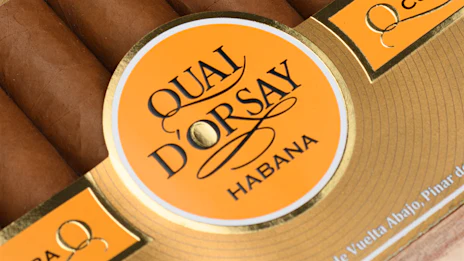
DeSantis: I would do it when I was at college, at law school, here or there, the military a little bit. And then as I started playing golf, I would do it, but I wasn’t really serious about it. I didn’t really know much about the different brands. But if someone offered me one, I liked doing it. Then I got elected governor in 2018, and the incoming speaker of the house was José Oliva from Oliva Cigar Co. He would come over here a lot. We would smoke cigars, and he started introducing me to all the great companies throughout Florida. So I got to meet Padrón and Fuente and all this stuff. And I became more sophisticated about it. And, quite frankly, I started reading Cigar Aficionado as well. And so I became a little bit more well versed. And then it led to this commemorative box. [He opens a box of cigars with his name on the lid, containing a host of cigars made by companies headquartered in Florida.] When I was running for reelection, we wanted to do something for supporters who really went above and beyond to say thank you, so we did this limited-edition cigar box. And what we got is some of the major companies in Florida to contribute. So you got OpusX, you got Padrón, you got Oliva. It’s kind of a unique thing. So that was really, really exciting when we were able to do that.
Savona: Was that for a fundraiser?
DeSantis: Say you did a fundraiser for me and you raised a bunch of money. I would come to your house and I’d give you this. Then I started developing relationships with the folks from these companies in Florida and they were under a lot of heat from the FDA at the time. Look, cigarettes are regulated. I get it. But to apply that to premium cigars, the way these things are produced, would have been an existential threat to their businesses. So I was very active in opposing that and working with them. It eventually got litigated and they were able to keep it at bay for the time being. We worked with the Trump administration to say, ‘Hey, you guys got to dial this back. This is not what you’re trying to do. This is not the same thing.’ So I just developed relationships with people in the industry and it became something that I became proud of as governor that we have some of these great companies here in the state of Florida.
Savona: It’s really the headquarters of the cigar industry.
DeSantis: We have kind of the early Cubans, pre-Castro, the Ybor City stuff, then you have some that were the exiles that fled Castro. So we have a mix of both. Tampa obviously is our most historic Cuban community because that started really in the 1890s. And then when you get into Miami, you really have the post ’59 folks who came and started businesses. And a lot of times their businesses were taken by the communists. And so they had to start all over in Florida.
Savona: Tell me about when you smoke cigars.
DeSantis: Golf, social events and when I wrote my book, what I would do is just do my job full throttle and then, when the wife and kids fell asleep at night, like 11 o’clock, I would go and write. My breaks would be here [on the patio] thinking about what I’m going to write, smoking a cigar and usually having a Scotch.
Savona: And you obviously like Olivas.
DeSantis: I’d say Oliva, Padrón and Fuente are probably the ones I do the most. But I’ve had all these over the years. I mean, I’ve had a lot of Plasencias. I like those. We’re really blessed to have a lot of good brands here.
Savona: Do you remember your first cigar?
DeSantis: No, but I think it was something to be social with. Because back then, cigarettes were more prevalent than they are today, but that just wasn’t something that was really my cup of tea. I didn’t want to be doing cigarettes. I wanted something a little bit different. So if we were out and were with friends, particularly when we started getting into golf, that’s an easy thing to have on the golf course, or when you’re unwinding after a round of golf . . . Now, once I started getting into politics, I did have opportunities presented to me to do Cuban cigars and I rejected that because the communism, I don’t want to feed it. So I’ve never done an actual Cuban cigar.

Savona: You’ve never smoked a Cuban cigar?
DeSantis: I’ve never had a Cuban cigar for ideological reasons, but I look forward to doing it when there’s a free Cuba, and there very well may be in the not-too-distant future.
Savona: You brought up Cuba. Cuba is a mess right now and it’s all over the news. The Trump administration has talked about regime change, cutting deals. What do you think is going to happen in Cuba? Where do you think this goes?
DeSantis: I think if you look at what that regime did when it came to power, the persecution, exploiting private property, seizing private property, causing an exodus of some of their most productive people to the United States of America, you would not have thought that this regime could have held on this long. It is basically a third-world country. It is one of the most pretty islands that we have in the world. If you had a free government there, Cuba would boom. Cigars would be great, obviously, although I think our people here in Florida do it as good as anyone. It would be a great tourist destination. There would be so much potential. So I’m surprised that it’s lasted this long. I know there have been fits and starts. We had an opportunity in the early ’60s to maybe do something, and then it’s just like they’ve been holding onto power. So I would love to see a free government.
I’m not sure exactly how you get there. The Venezuela model was snatch Maduro, but then everybody else is there, and basically you’re holding the Sword of Damocles over them saying, ‘Hey, you got to behave a little bit better. If you don’t, this could be you.’ I think the corruption of the communist dictatorship is so endemic to their society that you really do need just a clean slate . . . . When they were rising up in 2021, I reached out to Elon Musk about trying to do Starlink because the regime shut the Internet down. Starlink is amazing, but you have to have the device present with you on the ground in order to get it. There were also these hot air balloons, where your device could get the Internet from the hot air balloon. So we were going to fund it from Florida to be able to help. But basically these guys were business guys and they were worried the Biden administration would take their license, because the Biden administration was not necessarily in favor of helping the Cuban people. I mean, you’ve studied history. Castro was like a cause célèbre for the far left, so it’s just a different mindset. Whereas for us in Florida, there was no question. We wanted to see the people prevail. So I was willing to fund a hot air balloon for Internet to go over there and it didn’t happen. Clearly there’s dissatisfaction in the regime. Clearly people are destitute, but they use a lot of force and there’s a lot of risk if people speak out and try to do something.
Savona: I think most people are surprised the system there has lasted so long.
DeSantis: Particularly with the results. Back in the late ’50s, there was this debate between capitalism and communism, American freedom versus the Soviet system. And we obviously saw how that ended when the Berlin Wall fell. So the evidence is very, very clear. At the time, [Castro] was selling a bill of goods and that’s how he seized power, right? And what did he produce on that? He produced nothing but misery. The entire system is meant to maintain the elites in power, and the elites live like kings in Cuba. I mean, if you’re high up in that communist party, you are living high on the hog. Everyone else? Not quite as rosy.
Savona: I feel bad for the people of Cuba because I’ve been there. I’ve got friends who live there and I’ve seen first hand how they live.
DeSantis: You also think about, as governor of Florida, you look at some of the major successes in business from the Cuban exile community in South Florida. That would have been done in Cuba. You’d have major companies, successful companies,
medical advancements. They had the talent and they drove all the talent out. And so that’s now become a big pillar of Florida’s economy. But some of the best businesses in the country have been started by Cuban exiles. So it’s a success story for the people who were deprived of everything to come here and do what they did, but it also just shows you, man, what a missed opportunity for the island of Cuba. They could have been allied with the United States and they would have done very, very well.

Savona: Let’s go back to when you were a young man. You played baseball, and your team reached the quarterfinals of the Little League World Series. What was that like?
DeSantis: That is one of the biggest things you could have as a 12-year-old because back then there were only four teams that made it in the entire United States. To start out in Little League at the beginning of the season and make it to the World Series, the odds are astronomical, right? We lost to California. Back then, it was single elimination. They changed it the year after us, because we were the best American team. We just ran into this guy who was throwing 81 miles an hour from 45 feet away . . . . We were a really good team.
Savona: Back then, did you want to be a pro baseball player?
DeSantis: One hundred percent. All the way until I got into college, I wanted to do baseball and I would have chosen to do that over anything. I played four years in college [for Yale] and I was a captain of the team. So I was a good college player. I was a four-year starter, all that stuff. Now my plan was, if I couldn’t play, to stay in baseball, maybe in the front office. And that was when you started to have the trend of people from places like Harvard and Yale going into these front offices. A lot of them have become GMs [general managers] since then, including some of my teammates. And then I think what happened to kind of change that trajectory was 9/11, and then I joined the military.
Savona: Tell me how 9/11 changed your trajectory.
DeSantis: I took this for granted: growing up in the ’80s and ’90s—I graduated high school in ’97, graduated college the May before 9/11—it was a great time to be a kid in America. The finishing of the Cold War, the Berlin Wall falls and then the Soviet Union goes away. And then the ’90s is like a holiday from history. We didn’t have a care in the world. The country was doing well, and then 9/11. There’s bad people in this world and there are people that want to do bad things to the United States. And so I saw that the posture of the country was going to change, obviously in terms of Afghanistan, so I was like, look, I have the opportunity to be able to serve. You get one shot at doing it. I’m in my 20s, I can do it. So I commissioned [he joined the U.S. Navy in 2004] and then when I finished my schooling [he graduated from Harvard Law School in 2005] we went and did it. And then when I got there, you didn’t necessarily have to deploy to Iraq or some of these places, so I volunteered to do that. I did some temporary assignments down in Guantanamo when they had Khalid Sheikh Mohammed and all them, but then I did the full deployment to Fallujah [Iraq]. So I was the commander’s advisor. I oversaw detainee stuff and some of the interrogation stuff for Navy SEALs. I remember hitting the ground in TQ Airbase. It’s pitch black because you flew at night because if you flew during the day, they would try to take pot shots. So we come in, pitch black, I get my boots on the ground and I thought to myself, two or three years ago, you were at Harvard and now you’re in Fallujah. That’s a road less traveled for a lot of people, but it was a good experience. First of all, I wanted to serve, but then also just the military, leadership, discipline, all the things that I had exemplified as an athlete, but really, these were life-and-death situations. And I had a small role, but we were a team there too.
Savona: Were you ever shot at?
DeSantis: I was not. When we would travel the country, we would go at night by helicopters. If we went during the day, you would have gotten shot at. But at that time, you go pitch black, all the lights go off and you go—I mean, so you just don’t know, right? And then when you’re driving on the ground, you really weren’t getting shot at, but the thing was, is there going to be an IED [improvised explosive device], and fortunately I didn’t have that. That was how the enemy attacked. It was asymmetric. In fact, when I was there, we had very few normal firefights with enemy forces. It was a terrorist insurgency and incidentally, we were there when the Sunni Arab insurgency was really pacified and then as we were getting ready to leave, we saw most of the casualties being done by the Iranian-backed militias.
Savona: Thank you for your service. How did your time in the military inform you as a politician, and as a governor?
DeSantis: Well, I think a couple things. One is just kind of service above self. That’s just what you do. You’re there, you’re wearing the uniform and you’re serving others, you’re not serving yourself. And if you serve yourself, they show you the door. The other thing is attention to detail, training, being ready for the mission, whatever your role is, you got to do it or there could be big trouble. But then in terms of the geopolitical, we get on the ground and the whole thing was, ‘Well, we want a democracy here. We want freedom here.’ Their view of freedom was Sharia law. They felt that was freedom. Now, we would not view that obviously in America as freedom. So we were trying to impose a system that was not conducive to their culture.
This is America’s 250th anniversary. You go back in 1776, you go back in 1787 when they were crafting the Constitution. I mean, you had centuries of Western culture that had built up. The enlightenment. Our founders knew all the heroes from the Roman Republic, and ancient Greece. You had religious traditions. You had all these different things that came together so that when they did the Declaration of Independence, this was muscle memory for them. It made sense. If you didn’t have all of that leading up to that, to just come and impose our founding documents, it would not have worked. And so I think we’ve learned a lot as a country about what can we actually do and there’s certain things we could do. If there was a military operation that needed to get done in Iraq, our guys did it and they did it well and they succeeded. But okay, you want a Western court system? Well, that’s not what they want to have, right? You want a democracy where people vote? Well, our founding fathers didn’t want it to just be a 50 percent popular vote . . . so they built a system of checks and balances where you would have different branches of government, different levels of government, state and federal, and they didn’t want a consolidation of power. And I think what happened there is, it’s a ‘democracy’ where people can vote, but they don’t have a free society. They don’t have institutions that are protecting individual liberty, particularly when you’re in the minority. It’s easy to protect people’s rights if you’re in the majority, but what if you’re in the minority on an issue? Religion, politics, economics? Well, then it becomes a lot more dicey if you’re just having a national plebiscite.
Savona: After you served in the military did baseball become a distant memory?
DeSantis: I became very interested in public service… I started speaking throughout Florida and I started developing a little bit of a following . . . . I’m speaking in front of a lot of like more elderly people in Florida and they liked the fact that I was a young guy and that I had strong principles. They liked that I was a veteran . . . . Then what happened was the redistricting year, so Florida gained seats, so they had to redraw the district lines. And so we were living in Ponte Vedra Beach in Northeast Florida. There was a district from there down to Daytona Beach that was a vacant seat. There was no incumbent. So a bunch of us, seven Republicans, ran in the primary. I had never run for office. No one knew who I was. I didn’t have any campaign money to start . . . . We did a fundraiser in New York City at a steakhouse. We were probably smoking cigars on that one. And then my wife [Casey] and I would knock on doors. My wife had a motorized scooter. We put it in the bed of my truck. I would drop her off on one side of the neighborhood. I would take the other and we would go, hand them a flyer, she would say, ‘Hey, my husband is running for Congress. I’d love your support.’ And when you shake someone’s hand like that and say, ‘I want your support,’ to this day, people will come up to me and they will say, ‘You knocked on my door. Your wife knocked on my door.’ It’s something that they remember. So we knocked on thousands of doors over the course of that. We won by almost 20 points in that primary. That’s a big deal. But a lot of it was just we outworked. We worked hard. If we’re going to do it, we’re going to do it right. We’re not going to leave anything on the table and we’re going to get the job done.

Savona: When you got into politics, Florida was still a swing state, which it is not anymore. And recently, of course, the population here has really soared, especially in a post-Covid world. It seems like everybody from my neck of the woods is moving down here or has moved down here. Why Florida?
DeSantis: If you go back to the decade before I got elected, every major race, governor 2010, president 2012, governor ’14, president ’16, and even my first election, one point, one point or less races. We were almost 50/50, the biggest swing state, the most important swing state. I remember when Trump was running against Hillary in 2016, you could not turn on a TV channel without seeing ads everywhere, mostly from Hillary. 2020, Biden, Trump, I mean, this was the battleground.
So I get in and people are just like, ‘Listen, this is a very delicate balance. You may need to trim your sails a little bit. You got to navigate and all this.’ And my view was I told people what I was going to do. I got elected. I’m going to use the authority I have. I’m going to deliver an agenda. And if they like it, then we’re going to be rewarded, and if they don’t, that’s fine. But I’m not going to be somebody who I’m not. Well, I just believe in bold colors, not pale pastels, and I wanted to take on big issues. And even though I would say we’ve been the most successful conservative state in the modern history of the Republican Party, I was doing things that had broad appeal. We’ve done the biggest environmental restoration, with our Everglades restoration, in the history of the United States. When I came in, it was floundering, now it’s flourishing. And because President Trump’s helping us on doing the federal share, we’re going to have all of this completed, which nobody thought was possible. We’re doing things on education. But what you’re doing—be bold and go do it. So that’s what it was. So then 2022, the one-point state, no more. I won by the biggest victory in the history of the Republican Party for a governor’s race in the state of Florida. So how does that happen? It only happens because you’re producing results that people like.
We’ve had a couple things happen. We have had migration. There’s no question about it. Part of it is, I think we were doing a good job. Part of it was we were the refuge during Covid when so many of these other places clung to these restrictions. We said, ‘You have the right to operate your businesses, work, school, all this stuff.’ People did appreciate that. It was also during the period where you kind of had the peak of the great awokening [sic] with the BLM rioting in the summer of 2020. We said, ‘We are a law-and-order state. You want to protest peacefully? You have that right, but do not engage in mob violence, loot, do any of that. We’re going to hold you accountable.’ And so the law and order was really important because what I was seeing from people fleeing was, yeah, the taxes, but we’ve always had lower taxes, right? That’s not anything new. Some of it was Covid, but a lot of it was they felt in the big cities that the politicians had turned their back on public safety . . . . The result is we’ve had more income move into Florida since I’ve been governor than has ever moved into another state in all of American history. In 2023, Florida added $20.4 billion of adjusted gross income.
Savona: What does it do to change the makeup of the state when all that wealth comes in?
DeSantis: Well, when I became governor, our economy was about $1 trillion, $1.1 trillion, in that range. Now it’s $1.85 trillion seven years later. So what we’ve seen is because we have no income tax, reasonable regulation, limited scope of government, we now have strong courts that are good because I’ve appointed people at the Florida Supreme Court. We’ve created a virtuous cycle. We’re trying to cut as many taxes as we can and the revenue keeps growing for the state because the economic pie is getting bigger. And so you’re taxing less, but you have a bigger pie and so the revenue ends up bigger.
I think the contrast from the high-tax states, what they’re doing, when they do high tax, bad regulation, that does cause businesses to flee. It constricts their economic base. So then when they’re doing the taxing, they’re not getting the revenue they expect so they go to the well again. And I think that creates a vicious cycle. For us, we have a virtuous cycle, so that’s been good. Now, when you have people coming, it does create challenges, right? Because we have counties in Florida—we were in Ponte Vedra Beach before I was elected governor, great place, St. Johns County, great community. I think the population has, since when we bought our house and we got married in 2009, I think the population in that county has doubled. That’s a lot. Just think about building schools, roads, the utilities, the services, the traffic. So as we got into Covid and a year or two after that, I’m seeing the traffic increase. So I was like, alright, we do $15 billion a year in transportation, mostly roads, but . . . we have bad traffic now. So, I accelerated, I did a thing called Moving Florida Forward and we plowed seven billion in to take projects that weren’t even supposed to begin until next decade and do them now. So we’re delivering those five or 10 years ahead of schedule. And the reality is we already know we need to do it because we’re seeing the traffic now. So, it does come with challenges.
West Palm has really grown, some big businesses have a big foothold. Steve Ross, owner of the Dolphins, has been a big part of that. If you go to Miami, you have four of the five wealthiest people in the world that live there: Bezos, the Google guys, Zuckerberg. And then things have gotten more expensive there because the wealth’s coming in. So if you’re working class, it’s just harder to afford. So that’s definitely a downside.
Savona: You’ve been governor for seven years. Your term is up in January. What do you want to accomplish before the end of your tenure? And then I want to talk about what happens after.
DeSantis: So what we want to do is give the voters an opportunity on property tax. Property tax is all local. We don’t get any of the revenue. Local governments were taking in $32 billion in 2019. Now they’re taking in $60 billion. And so people are strapped on property. And it’s not even because the millage is going up, it’s the valuations. So we have something called a homestead. So if you’re a Florida resident, you can identify a property to exclude from property tax . . . . They could still tax the Airbnbs, the snowbirds, the commercial, just like they do now. And you’d have to phase it in, but because our base has grown and revenue has grown so much, you actually could do it. So we’re working with the legislature to get a proposal to be put on the ballot in November. It would need 60 percent of the vote, but this would be historic if we were able to do it.

Savona: So this would protect the people who basically are a victim of their appreciating home values?
DeSantis: Yeah, absolutely. And look, your homestead, we want you to own it. If you’re 78 years old and you can’t afford the tax, they shouldn’t be able to take your house. We can’t control the barrel of oil globally, I can’t control the supermarket prices, but what I can do is control the tax through this referendum. If someone owns a home worth $500,000 and now that’s exempt from property tax, that’s revolutionary for their family.
Savona: So what’s next? Will you run for president again?
DeSantis: I get asked that all the time. So who knows? My view is I got to run through the tape. After eight years, if we keep the pedal to the metal, keep having success, I’ll be able to say you cannot find an eight-year tenure that’s been more consequential in the modern history of the Republican Party, honestly, in the state or in the United States, certainly this century. We had a political effect that is unprecedented: economic effect, education reforms, Everglades restoration, biggest in history, all these different things. And you know, so much of politics nowadays is theater, it’s the food fight. And I think people are like, ‘Okay, where are the results?’ Well, we have done results. There’s a quote from Calvin Coolidge that I like where he said, ‘You cannot successfully administer the government by substituting the power of entertainment for the power of accomplishment.’
We’ll see what the future holds. I’m not somebody who says I have to be in elected office. There’s a lot I can do other than that. But in terms of politics, we’re in a volatile political time. We don’t know what things are going to look like two months from now let alone two years from now.
Savona: Running for the presidency: How did that compare to running for governor?
DeSantis: Well, I think there’s two big differences. One, you had a former president. It was just a weird thing. He didn’t really participate in the debates because he kind of didn’t need to. He had a lot of support. When they started going after him legally, people rallied to him . . . . I remember I was at an event, I spoke and a fella comes up to me and says, ‘You’re going to be a better president than Ronald Reagan.’ And I’m thinking to myself, ‘Oh yeah, thank you.’ And he’s like, ‘And if Trump weren’t running, I’d vote for you.’ And I’m like, ‘Well, If I can’t win a guy that thinks I’m like Reagan” . . . that was different than any other Republican nomination fight that you’d have. So that’s that. But then beyond that, in Florida, there’s not incessant coverage of running for governor. People see I’m doing this, I’m doing results, I’m getting that, but it’s not kind of the narrative and the food fight every day. With a presidential [election], it’s every day. So the media and dealing with the networks and podcasts, you’ve got to be in that game.
But I will also say Florida is very much a microcosm of this country. You go west of here, it’s right on the Alabama border, it’s southern. You go to Miami, it’s Latin America basically. You go to Palm Beach and Fort Lauderdale, it’s New York south, Boca Raton, right? It’s the sixth borough. You go to Southwest Florida, it’s like half the Midwest is down there right now. You run into people from Minnesota, Michigan, Indiana. Where I grew up in the Tampa Bay area and then also in Orlando, it’s kind of a mix. So you really have like four or five different states in one. And to be able to do what I did, winning Pensacola by 30 points, but then also winning Miami by double digits, I was the first Republican to win Palm Beach County in 40 years, that is not easy to do because those constituencies culturally are just different. And so to be able to have appeal across that, that’s the type of thing that you need to do nationally.

Savona: Let’s talk American politics. The country is divided. There’s people on the left, there’s people on the right, there’s independents and people are angry at one another. There’s a lot of vitriol out there. Is the political outlook very different now than when you first entered politics?
DeSantis: I didn’t know who was a Republican or Democrat when we were growing up. This stuff really never came up. We were kind of living our lives and doing our thing. When I got to college, I didn’t even know colleges were liberal, so I go to Yale. Some of that was a shock to me, but even then, I’m playing baseball, I’m studying, I wasn’t involved in campus activism or politics. And then I think 9/11 obviously changed it to a certain extent. Iraq divided the country. You got into the financial crisis, people haven’t been doing well, I think, working people, because the people with assets have done better. So a lot of them feel like they’ve been left behind.
I went through Yale and Harvard Law School. I’ve been around a lot of people that think a lot differently than me. You can’t go through life not being able to talk to someone because they have a different view on taxes or criminal law. It’s not an appropriate thing to be divided to the death over. I think that political allegiance, in some respects, has substituted for religion to a certain extent, and the more politics is central to people’s lives, I don’t think that’s ultimately healthy. Politics has a role. We have elections, people hopefully serve well in office and deliver good results, but most of what you do as an American is totally divorced from whatever the hell the federal government’s doing. And the media landscape feeds this because it’s not just a few networks. Now, you got a podcast for everything under the sun. If you have this hobby horse, you can do it. If there’s some itch in the electorate that isn’t being serviced, some podcasts should come. They can monetize that. You go on social media and monetize it. So it’s creating, I think, incentives for division, because the division ultimately sells.
Savona: What do you think of where we are in the world right now? We’ve got military action going on in Iran. We’re talking about potential regime change in Cuba. Are we in a more dangerous spot, or is this business as usual?
DeSantis: I think there’s a lot that’s in flux in the world, and so I think the range of outcomes is a lot broader than maybe under normal circumstances. Could we have a new free government take over in Cuba and everyone live happily ever after? It could happen. It could also not happen. And you could have more people get hurt. What’s going to happen with Iran? The Iranian government has been the most hostile of any government to the United States. They killed a lot of our service members. I clearly would love to see a pro-Western government there. Easier said than done. You can’t just snap your fingers and do it. You’re in a situation where the Israelis, they did a decapitation strike where they killed the Ayatollah, and I think the thought was that if they did that, maybe the people would rise up and overthrow the government. Well, that hasn’t happened yet. And when people took to the streets in January, they got slaughtered by the thousands. And so now you have kind of a next generation: Are they going to be more hard line? How does that work? But as long as you have a militant, theocratic Islamist regime, they are going to be hostile to the United States of America. But to get beyond that, there’s a lot of risks involved with that. Clearly, if you could snap your fingers, U.S. policy, we would love to see a pro-Western government.
I think Iran, Cuba, if a year from now there’s pro-Western governments and they liberalize, that would be great for the world, but there is a lot of roadblocks to be able to get there and things could obviously go south from there.
Savona: If you were president right now, which of all these situations we’ve talked about would be the one that would worry you the most, or is it something else?
DeSantis: Geopolitically, our top rival is China. We saw with Covid how susceptible we are to the supply chain. They have a lot of ability to disrupt there. They’ve grown their military. They want to be the dominant power in the Indo-Pacific, that obviously would have implications for us. I would say the civilizational struggle is more of the Islamic jihad, both the Iranian version as well as kind of the terror. That’s not dead. And my concern with the southern border was some of these groups may have infiltrated, probably surely have infiltrated the country. It is an issue of geopolitics, but it’s also an issue of migration because I think the migration to Europe from the Islamic societies have changed the underlying culture of Europe . . . . We maybe don’t talk about the ‘war on terror,’ but that threat is still there and it’s going to be something that Europe’s going to have to reckon with, in many respects, because of some of the choices they’ve made.

Savona: Heady stuff.
DeSantis: What’s the saying? You don’t want to live in interesting times? Ultimately, I think the goal of leadership and statesmanship is to, when you have hard times, to produce leadership and policies that are going to lead to those more tranquil times, I mean, that’s what you want to get to.
We’re at America’s 250th anniversary. And first of all, just to launch the War for Independence, in some respects was like a one-in-a-million shot. And they knew if they didn’t succeed, they’d die, but they felt very strongly that they needed to take a stand for their rights. And so they laid out a philosophy behind that. Even though the revolution itself was conservative—‘We just want to be treated like normal Englishmen. You guys aren’t giving us the same rights, you’re treating us like second-class citizens’—but the implications of what they wrote on paper have been a huge transformative force, not just here, but around the world.

They create a constitution and Benjamin Franklin walks out of that convention and he’s asked, ‘Did you give us a republic or a monarchy?’ And his answer was ‘a republic—if you can keep it.’ So he understood you could have the best constitution in the world, the best Declaration of Independence in the world, but they don’t run on autopilot. Every generation of Americans has to stand up, defend freedom when it’s threatened and make sure that this can endure, because they knew republics throughout history had failed. And so they really believed it was the U.S. that would answer this question once and for all. Can people govern themselves or not? And if they can’t, then we’re going to live under various forms of despotism. And so part of what I conceive of us doing here is yes, if I have to respond to a hurricane, if I have to fix a road, if I have to do that, yes. But in a larger sense we’re answering Franklin’s question: Can we keep a republic? Can we govern ourselves or not? And I think in Florida we’re showing self-government can work. We can do it. We can produce results that people like. We can attract businesses. We can attract individuals and give people an open field and fair chance to let their talents take them as far as they want to. May not be the case in every corner of this country where people are super excited about the results of self-government given some of the results. But I think here, we can look back, 250 years back to now and I think we could say the founding fathers would be proud of what we’re doing here.