J.C. Newman Fighting To Stay In Tampa
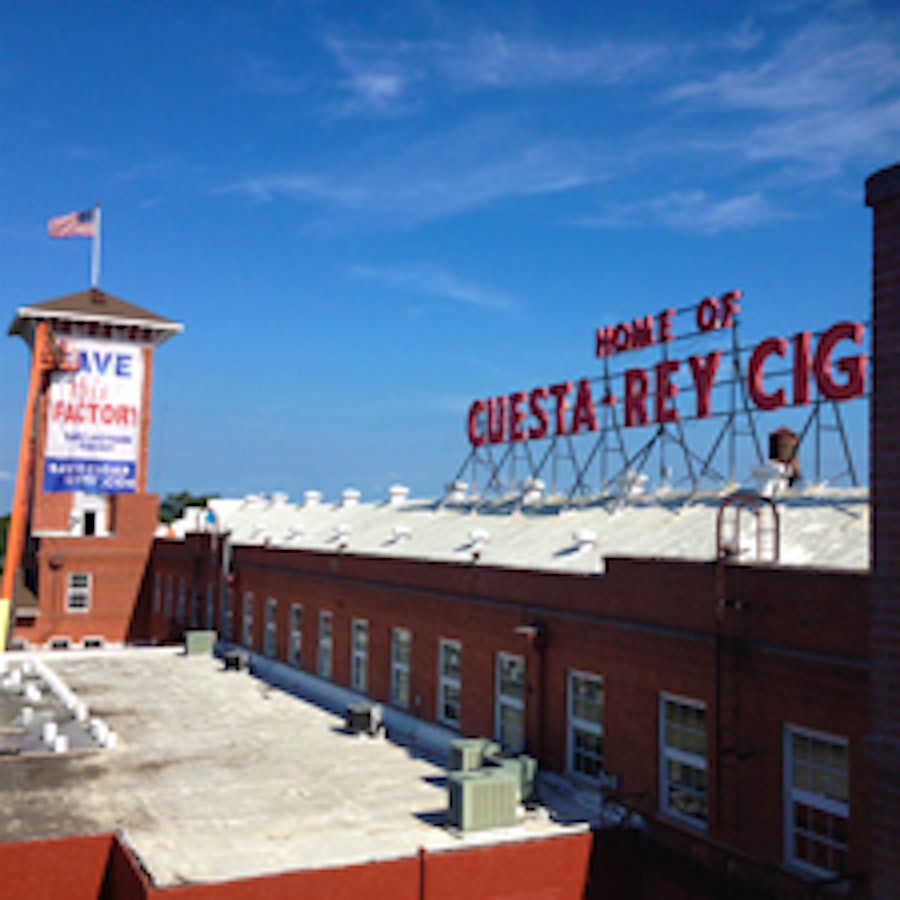
Food and Drug Administration oversight of the United States cigar industry is threatening J.C. Newman Cigar Co., the last major producer of cigars in Tampa, Florida, a city that was built by tobacco. The 119-year-old company does not intend to go down without a fight.
Earlier this week, workers erected two 30-foot-high, 20-foot-wide banners atop the clock tower that dominates the J.C. Newman headquarters, imploring locals to speak out for the factory.
"Can you imagine taking the wine out of Napa Valley or the French out of the French Quarter?" said J.C. Newman president Eric Newman, the third generation in his family to run the company that owns such venerable cigar brands as Cuesta-Rey and Diamond Crown. "Under the proposed regulations, that is exactly what the FDA will do to Tampa's rich cigar history."
The banner is one of two that will eventually fly from more than 100 feet over Tampa, which used to be the heart of American cigar production and was dubbed Cigar City. (Some 500 million cigars were rolled there in 1929 alone). Today, J.C. Newman is the only company making cigars in Tampa other than tiny operations making a few cigars here or there for the tourist trade.
All of J.C. Newman's handmade cigars are rolled offshore. The Fuente family, J.C. Newman's long-term partners, roll Diamond Crown and Cuesta-Rey cigars for the company. Other brands, such as Brick House, are rolled under contract in Nicaragua. But old machines still operate in Newman's Tampa headquarters, making cigars from mixed-filler tobaccos, homogenized binders and natural wrappers of various types. The company uses Connecticut shade and broadleaf wrappers as well as those grown in Ecuador, buying slightly blemished ones (or those with imperfect color) in order to produce cigars at a lower price than those made with first-grade wrappers. The inexpensive smokes sell under such names as Factory Throwouts, Rigoletto Black Jacks and Mexican Segundos, for around $1.50 apiece.
The cigars are made on antiquated machines that work much slower than modern-day, traditional cigarmaking machines. But the cigars do not meet the criteria for premium cigars, an exemption being considered by the FDA.
"We are unique in the U.S. and the last operating cigar factory in Cigar City, we fall into a dangerous category. We don't fit the premium cigar definition, but since we are an antique operating factory we also don't fit the mass-market niche," said Shanda Lee, vice president of marketing for J.C. Newman. "The banner is hanging on our clock tower that faces one of the busiest interstates with the most densely populated business district in Florida."
The idea is to get the message to the millions of commuters who drive by each day, in hopes of keeping the cigarmaking machines running in Tampa.
To read all about the Newman's factory, read Last Men Standing.