Q&A: Adam Levine Of League Of Fat Bastards Cigars

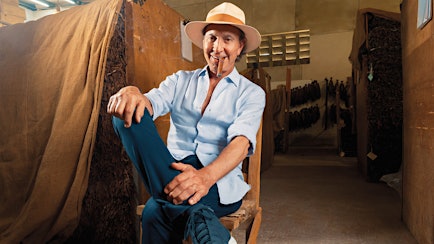
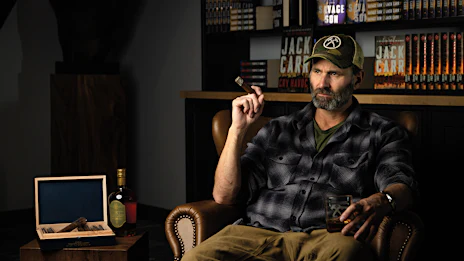
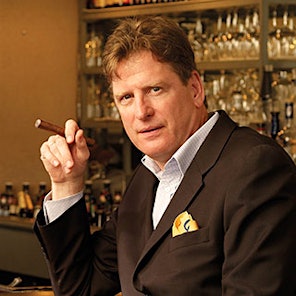
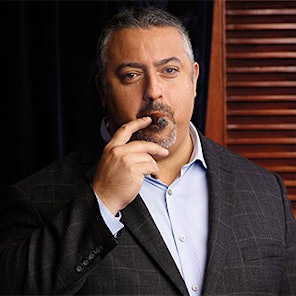
May is Mental Health Awareness Month but the fight doesn’t end on June 1. Aussie entrepreneur and cigarmaker Adam Levine crusades for men’s mental health all year round. His company, League of Fat Bastards, highlights the social, yet introspective, side to cigar smoking where men can come together and wax eloquent as cigar ashes form. While his brand’s name is humorous, his mission is serious: Levine says that 40 percent of profits from his brand are donated to men’s mental health organizations—including veterans and first responders. Levine may share the name of Maroon 5’s front man and resembles Keanu Reeves in John Wick, but he is his own man who wants to start a dialogue with those who need it most.
Cigar Aficionado associate editor Thomas Pappalardo sat down with Levine recently in the Cigar Aficionado offices in New York City to talk about his story, his mission and, of course, his cigars.
PAPPALARDO: So, you’re still a relatively young company. How long have you been around?
LEVINE: We’re only two and a half years old.
Q: Tell me about your background prior to becoming the owner of a cigar company.
A: From a technical basis, I’m a lawyer and investment banker. I've worked in Australia, I’ve worked in London, mainly focused on financial service-related transactions and the financial service industry. And, in fact, it was during my stints when I was in London, back in 1995, that I first sort of got involved with cigars, and found the passion for cigars. I was working for a company called Schroders in the U.K. And Schroders is one of the traditional, old-school, historic U.K. investment banks. When they hired me, it was in the good old days when you could still enjoy cigars in office buildings.
The managing directors of the business—the big guys—would always sit and have a cigar and talk. And these are traditional, like traditional, investment bankers: chalk-stripe suits, the whole thing. And I thought, ‘I want to blend in here, so I better understand this cigar thing.’ So, I was living in a street in London which is called Jermyn Street, which is Piccadilly. Very famous street for a couple of reasons: One is because it has all the shirt tailors there… but most importantly they had a front there for JJ Fox. And I went into JJ Fox’s store and opened the doors and it was for the first time ever that I saw this amazing walk-in humidor. I went in there; the aroma just blew me away. My first cigar that I had was actually a Partagás Serie D No. 4.
So, my background is investment banking and then financial services, and basically for the last five or six years before I set up this business, I was really involved in owning, what I would call financial service businesses that really had a social bend to them and underlying social cause to them.
One of the biggest businesses I owned was a trustee company where we managed the financial affairs for about 1,200, 1,300 individuals who were appointed essentially as trustee guardians to manage their financial affairs because they were suffering from either acquired brain injury or they were suffering from drug addiction or alcohol, their parents or family didn’t want to look after them, so they appointed us essentially, as the Americans would call it, as a ‘guardian.’ It was called Flinders Trustees. We had this philosophy where we say no to no one. Which means that we will take you on under our trusteeship irrespective of what your asset levels look like—because most trustees want you to have a certain amount of assets so they can make money out of you and stuff like that. And I think what's really interesting to me is that that philosophy has always been really important to me in terms of that I describe myself as a ‘socialist capitalist.’
I have a fundamental view that society needs to provide for those who are most vulnerable. I think society needs to provide education, I think society needs to provide shelter, I think it needs to provide hospital services... But outside of that, I think society should permit people to run—as long as you don’t exploit anybody—businesses, make as much profit as they can, and then it’s what you do with the profit that counts. And, so that socialist capitalist mentality underpins, in essence, really the economic framework of what LOFB, League of Fat Bastards, is all about.
Q: So, how did you go from investment banking to cigars?
A: Let me take you a step back. I’m a first-generation wealth creator, started with $486 in the bank when I got married. I was 23, my wife was 22. Worked in investment banking, worked in law… And like a lot of people my age and also older, as a man growing up, we were always of belief and always taught you got to suck it up. So, it’s your responsibility to deliver for the family. It’s your responsibility just to get up and keep going. And you couldn’t show any weakness, you couldn’t show any suffering, you couldn’t show that you were in pain, you couldn’t show that you had doubts, and you didn’t want to talk to your friends about it because you were worried about how they might judge you.
And, what happens when we don’t have the opportunity to express the stress and the pressure and the doubts and the issues? They get built up, right? And it’s like a kettle. Just boils and boils and boils. At least a kettle has a valve, an off-switch, something to release the steam. If you don’t have an off-switch, you don't have a valve, what happens? You explode. And that’s what happened: I broke.
It happened to me just when I turned 50 and I remember it clearly. I was up at our holiday house up in the Queensland and I woke up one morning and I just was in tears. I could not stop crying. I didn’t know what was going to go on. I just couldn’t think straight. For three months, I was unable to communicate with the outside world. All this stress had built up and I just could not communicate. I couldn’t get out of bed. And this is in front of my wife, this is in front of my three children. They saw me go through this. I was constantly in tears.
It was like a waterfall of emotion just overcoming me all the time. And one day I went to the city and in Melbourne we have these trolley cars… I remember sitting there and I sent a text message to my wife just sort of saying, ‘Hey, I'm so sorry for all the pain that I've caused you. I'm so sorry for all the trouble I've caused you. You don’t deserve this.’ And, I just sort of went down and waited for a tram to come. I stood on the road and just waited for a tram to come hit me….
And, fortunately, the tram saw me and stopped. It was a shit show. And what was really interesting was once I was on this medication and was able to start thinking clearly… I’m Jewish by background, I’m not a very religious person, but it was like one day I was sitting there and it was like I had this feeling and it was like God sort of spoke to me and said, ‘Adam, I saved you for a reason. And your reason is because you’ve got a bigger mission in life. And your mission in life is to go out there, to use your experience, to use your knowledge, to use your influence, to use your power, to use your relationships, and to help other men avoid going through what you went through. To help other men smash that bullshit mask of masculinity that we all wear. And to create an opportunity for guys to open up and communicate and talk.’
I could have sat there and felt sorry for myself all the time and saying, ‘Oh, you know, why me? Why did this happen to me? I’ve been successful, I’ve been this, why did this happen to me?’ Why did this happen for me? That change of mindset from saying ‘Why did this happen to me?’ to ‘Why did this happen for me?’ it’s an unbelievably empowering mindset. And as soon as you start thinking about that, suddenly the negatives disappear.
And so, I thought, ‘Well, okay, how do I get out there and how do I engage with men and how do I speak to men and how do I tell men about this need to open up and smash this mask of masculinity?’ And I thought, ‘Oh my god, Adam, you've got the perfect vehicle: Cigars!’ Because cigars were always a way for guys to get together and share and open up and have a bit of a conversation, but what I needed to do was to create a brand that encouraged people to go deeper in that conversation. But that was the whole philosophy: using cigars as the vehicle for getting men together to start an honest, open, vulnerable conversation, to find a new way to chew the fat.
And chewing the fat’s having a conversation. I wanted to create this movement of men. I wanted to create a league, maybe. And I thought, ‘You know what? In order to be honest and genuine in conversations, you’ve got to be a bit of a bastard, you’ve just got to just say it straight, just be honest.’ And there’s your brand name: The League of Fat Bastards.

Q: How did your relationship with Joya de Nicaragua come about?
A: So, through a friend of a friend, who’s based in Nicaragua, he’s great mates with the family at Joya de Nicaragua. It’s an individual called Oscar Amador. He’s a good friend of mine. He said, ‘I know the Martínez family, Juan Martínez and his father, Alejandro, who are the owners of Joya de Nicaragua. I grew up with them. I think they would be good people to have a chat to.’ So, I connected with Juan, and this was the back end of the pandemic. And we connected via Zoom. I said this is what I want to do. So, the whole process of developing the cigar actually occurred over Zoom. We started with about 50 different blends, which he sent from Nicaragua to Australia. And then I would sit and produce these really detailed notes.
And we’d enjoy our cigars, and we'd talk about them and we’d taste-test. Then we’d go to the next one, then he’d send me the next batch, the next batch. It was five rounds we went through, five rounds of batches… and the last lot was really what became the Serie L.
The Serie L was designed very specifically to be what I call an everyman’s cigar. Not too heavy, not too light, not too spicy, not too creamy, but one that you can have anytime of the day, no matter what the time of the day. And that was done very purposefully because I needed to have the broadest possible appeal for the cigar to break into the market.
Q: I know it’s still early days and you have only two core lines [Serie L and Serie O] but do you have a best seller yet? Or is it still up in the air?
A: By the numbers, our Serie O Toro and Robusto are definitely the best sellers by volume. But the one that people tend to talk about the most, to be perfectly honest, is the Serie O Giggly Piggly.
Q: Any new lines to look forward to?
A: So, we have our core. We got the San Andrés for the Serie O, we've got the Ecuador Habano for the Serie L. The Serie F will be a Connecticut probably, and then the Serie B can be rotating. The idea is that we create unique each year… And once we’ve done it for this year, we're not doing it again. Next year, we’re going to do this, and that's what we're going to do.
The thing with the Serie B is really interesting. I’m interested to get your views and I want to get the readers’ views as well what we should do for Serie B. What I’d like to do is maybe use Serie B as our experimental series where we might do… they’re all special editions where we might do a Sumatra puro for example, where might do a Mexican/Honduran mix… I want to do stuff that’s just different, and unique. I’d really like to get some ideas for what some people would like in that rotation.

Q: Would there maybe be some kind of poll or something on your website?
A: If you want to, we can set one up easily! In the end, I want to produce what people want.
Q: You also have the Skinny Bastarda, which is made by the Quesadas. What prompted you to make that move from Joya to the Quesadas?
A: Unashamedly I focus on men's mental health, because that’s what I know, and that's what I can generally talk about. I am not in any way disregarding women’s mental health—clearly not. I have unbelievable respect for the support that women provide men when they’re going through a crisis. And they are unbelievably loyal, and they’re such good listeners and they’re just great partners. I wanted to create a cigar that paid homage to the women in our lives, to create an opportunity for women to enjoy a quality cigar that’s not flavored, that’s not a thin panetela, that’s a proper serious cigar that they can sit and enjoy with their male partner, with their brother, with their father, or with their girls, and have the same depth of conversation.
And what’s really important is there was only ever going to be one company that could produce it for me, and that was Quesada, and that's because it’s owned by the two sisters, by Patricia and Raquel. And so, it’s a cigar made by the women, for the women, but enjoyed by all. And it’s a bloody good cigar.
Q: I believe one of the main foundations you work with is Boulder Crest Foundation, and they help with first responders and veterans. How did that partnership come about?
A: Again, through mutual connections. The team there, what they do... they’re an amazing organization. They have a program which is called Struggle Well. And Struggle Well is a full-immersion program where you go away for—I think it’s eight days—off-site… And they strip you down, essentially, and deal with all of the issues of PTSD. They have different programs depending upon what line of service you’ve come from previously, so they have a first responders’ program, they have an active military program, they have a war vet program, they have an EMS program. Then they have a follow-up program after the in-person one, which I think is around 72 days.
So, it’s a really serious, deep program. It’s 100 percent for free. And it’s been going for a number of years, sponsored by some amazing philanthropic individuals. Ken Falke is the guy that set it up... He’s an ex-serviceman, set this business up and he’s got amazing supporters and amazing people behind him. I mean there are so many great organizations here in the U.S. that support things, but we wanted something that had a national focus.
Q: Now you said you wanted national focus. You have markets in other countries. Do you deal with organizations over there as well?
A: Yeah, so we do. So, the idea is that the 40 percent goes back. When we’re making profits, we’re allocating it against the various countries. So, the revenue streams and profits that come out of those various countries, they get allocated back to in-country organizations. So, Singapore is Singapore, Austria is going to be Austria, etc.

Q: So, explain how LOFB works as both a brand and as social venture.
A: So, LOFB is an entity, it has two engines to it. It has the community engine and it has the commerce engine. The community engine is the League and theleague.life. And that is our community hub. That is our core focus.
Our core focus is about creating these opportunities for men to get together, open up and talk. And we have resources online, we create forums of men—groups of eight to 10 guys that get together at cigar bars, at venues, at restaurants, at golf clubs, and have these deeper conversations that we facilitate. So, we have these conversation starters, we have these resources that men can use to open up and start these conversations. So, that’s really important.
The second engine that we have is the commerce engine. The commerce engine is the aligned lifestyle products, and our products are not just for consumption, they’re for conversation.
So, we have our cigar vertical, but then we also have our non-alcoholic beer vertical. We’ve just produced our first release of non-alcoholic beer [called LOFB] which is made in Florida, and that is a non-alcoholic Pilsner, and also a non-alcoholic hazy IPA. So, our first target is to work with our cigar retailers to also offer them and their clients a non-alcoholic beverage as well. And then we have some other verticals that we’re going to bring out in the future.
Q: Now, how has the public and the industry both responded to your mission?
A: I’ll give you an example. At PCA that we just had in New Orleans, there’s not one brand or one retailer that would have had grown men standing there in tears thanking you and coming up to give you a hug for what you’re doing. It was unbelievable. I was inundated. The emotional connection, the feeling of gratitude, the support that we are getting from consumers, from retailers for what we're doing is unbelievable. I had someone come up, a soldier, and salute me. That is unbelievable. It was quite extraordinary. And, you know, who am I? I’m just a guy who’s trying to make a difference in the world based on my own terrible experience, but it just resonates so deeply. And that is extraordinary.
In the industry, we have this philosophy that we are friends with everybody. We have no competitors. Look, obviously, I want people to enjoy our cigar, clearly. But I don’t really give a fuck whose cigar they enjoy, right? Whatever it is, the conversation, the community that we're building, that’s key… because, for me, cigars are the vehicle, they’re not the end game. The end game is the community.